
Why You Should Never Kill Someone Because Someone Else Wants You To
The psychology of scapegoating: recruiting patsies, implanting false beliefs

“There’s no way to rule innocent men. The only power any government has is the power to crack down on criminals. Well, when there aren’t enough criminals, you make them.”
- Atlas Shrugged, Ayn Rand
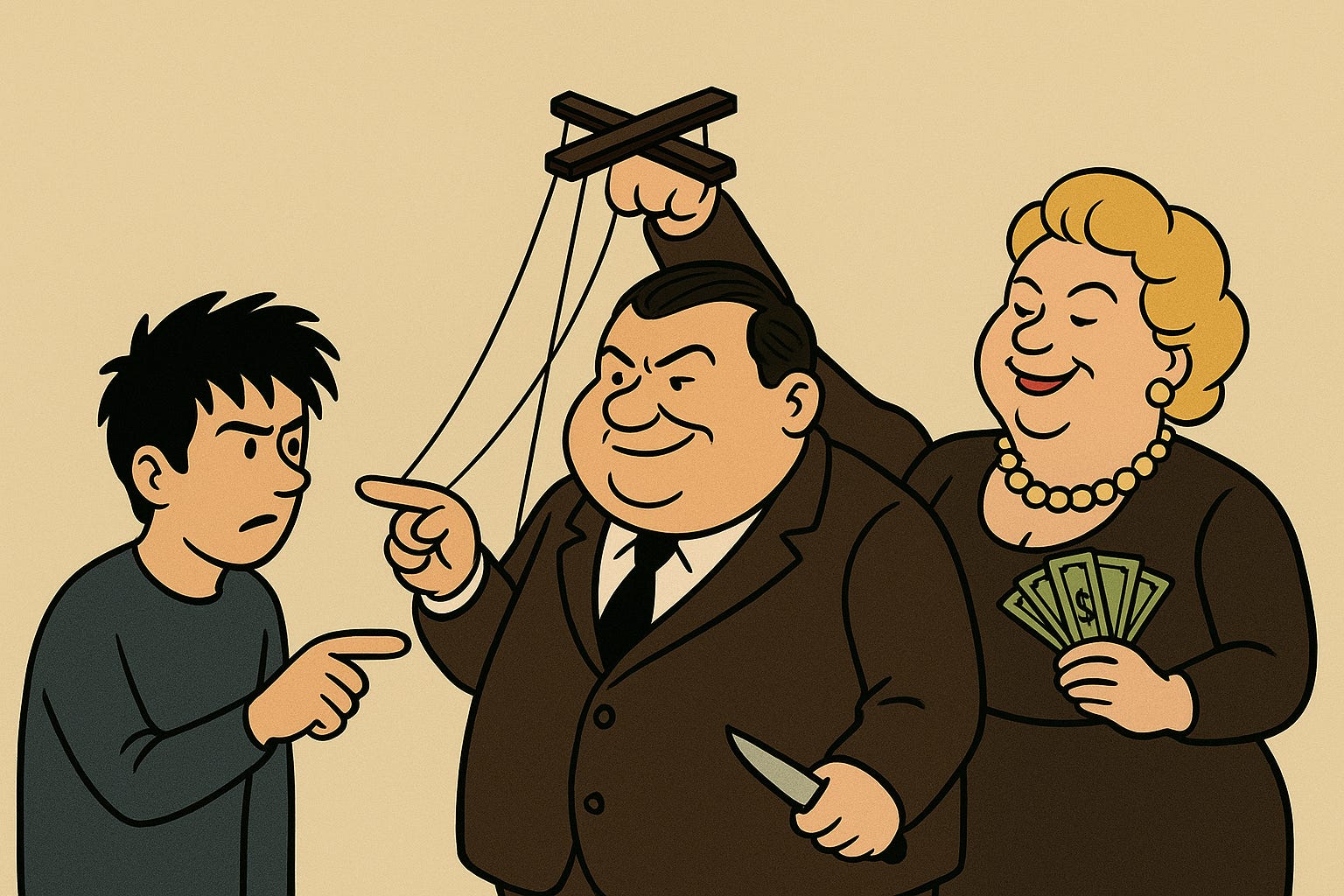
People rarely imagine themselves being “the fall guy.” However in business relationships, political alliances and personal interactions, it is very common for con-artists who are strategic to get others to make accusations for them, to facilitate a false-belief in you which will lead to an incorrect slander or even a falsely claimed miracle being believed by others. The ways in which you can be manipulated involve, ideology or true-belief, sympathy, greed, ego or coercion and compromise. Frequently the person targeting you, will use your own emotions against you, whether your desire for revenge or your longing for a lifestyle.
The most effective criminal schemes have not involved elaborate gadgets or genius masterminds, they’ve involved getting someone else to take the blame. When a manipulator wants a crime committed, the easiest path is not doing it themselves, but making someone else look responsible. The con-artist needs a gullible patsy or scapegoat as his underling he can use to absorb collateral damage in his plan.
In order to effect this end, an Operator will use an affinity scheme in order to implant false beliefs. These can involved money, common cause, your ego or Coercion / Compromise. This is one reason why dishonest actors are always “looking for dirt” or implying dirt, and later using accusation in order to coerce a man into being the patsy.
Moral Manipulation and Loyalty Pressure
A manipulator can hide their motives in the moral narrative that “you are doing the Right thing.” He can convince you that “This person deserves it.” or “You’re protecting someone.” or “You’re the only one who can do it.”
This creates a sense of duty or righteousness, and if the manipulator later claims they had nothing to do with it, the patsy is left holding the consequences alone. People underestimate how easily their moral instincts can be co-opted by someone with a hidden agenda.
Someone may exploit affection, friendship, or loyalty. This can involve some version of, “If you cared about me, you’d help.” or “You owe me after everything I’ve done for you.”
This is a classic technique used by abusers, cult leaders, and criminal groups. Once the act is done, however, loyalty becomes a one-way street: they vanish, and you’re the one exposed.
Withholding Information
People can be framed simply by not knowing the full context. For example: Not knowing something you’re asked to carry is illegal. Not understanding the real reason you’re being asked to be somewhere. Not realizing you’re being connected to a crime scene. This allows them to later argue that you acted intentionally because there is no documented trail of their involvement.
Creating the Illusion That “Everyone Is In On It”
Manipulators will often make you believe: “We’re all doing this.” and “Everyone knows what’s happening.” The con depends on getting you to believe that everyone knows this is “normal” and even if it is normal on some kind of systemic or statistical lever, that does not matter, because in this case, they know they are feeding you false information or withholding information.
In reality, you are the only one who will ever be linked to the act. Social proof is a powerful mind-bender, even when the group doesn’t actually exist, or the crime you are being asked to “stop” does not exist, and in reality they are setting you up to slander for them. This works in both ways, moralistically, they can get you to point the finger at someone innocent, even if that person might be stereotypically and statistically guilty. Likewise they can get you to commit a crime using the same logic.
Setting Up Circumstantial Evidence
Even high-level law enforcement warnings emphasize that you can be made a patsy through simple, everyday actions that create an incriminating trail without any specialized knowledge. For example, being encouraged to send a message that appears threatening, or to talk to someone on their behalf while they record you, being given things that later become “evidence” or being asked to “pay for something” that they can later use against you. Even by simply placing you at a specific location at a specific time or being tricked into touching or moving something or permitting something can be used against you.
These actions, innocent in the moment, later become the backbone of a criminal case. This is why people who want to commit crimes often rely on naïve, manipulated, or emotionally coerced individuals.
Isolation
The trick of “I care about you or I’m Looking Out for You” Gaslighting is also common. They can cut you off from other sources of information or confirmation, from friends, from alternative advice. This allows them to present themselves the only source of truth. When you have no alternative perspectives, you become dependent, and they gain total control over what you think the “right” course of action is.
Encouraging Self-Incrimination
Encouraging self-incrimination is another popular one. They can assert that they have done something, so you should do it too, they can exploit you when you vent in anger or discuss hypothetical plans and then pin you to real ones. Perverts love to believe that everyone else would do or necessarily must do what they themselves do, because this establishes them as a kind of moral authority above you. This also allows them to pin you to things you absolutely did not do. These become “evidence of intent,” even if you never actually did them. This allows the manipulator to stay aloof and in control.
The classic mistake of every patsy is assuming the manipulator has “skin in the game.” They do not. Criminal strategists protect themselves meticulously while pushing another person forward to take the risk. They end up with clean hands.
Conclusion
This is why you should never just do things at someone else’s urging, even if they are innocent things or things done out of moral righteousness on someone else’s behalf before you have full information about the content of the situation and the character or motives of the person you are talking too. You need to do your own investigation even into things the other person does not disclose, or might not even seem relevant to what they are asking.
In the case of doing actual harm, that can only mean one thing; they want the consequences to fall on you. Manipulation is subtle, quiet, and socially invisible, and that is exactly why it is so powerful. The person urging you toward a crime will not be there when the fallout arrives. The larger system will not ask, “Who encouraged you?” It will ask, “Who acted?”
In most cases if not all, if you are not at first being paid by a reputable source, even if you do not trust or agree with reputable sources, simply doing things on behalf of disreputable ones out of empathy, ideology or gain, can be an even bigger mistake. It is easy enough to dismiss the status quo and the woke as always evil or lying, but that does not subtract from the very real possibility and indeed, reality, that disreputable people also use people of good character and people of “good reputation” to accomplish their criminal goals.
For people who lack good reputation, or who have a reputation as a liar, it is far more effective to get someone who does not have that reputation to lie for them, or even to kill for them. This is the problem that all potential patsies need to think about.
Sources
Framed: Astonishing True Stories of Wrongful Convictions — A compelling account by John Grisham (with Jim McCloskey) presenting ten powerful real-world cases where innocent people were convicted. Great for illustrating how institutional flaws, corruption, or manipulation produce wrongful convictions. John Grisham
The Confidence Game: Why We Fall for It... Every Time — by Maria Konnikova
Deep dive into the psychology of con‑artists and why ordinary people fall for their schemes. Explains the typical “arc” of a con (how trust is built, how the mark is manipulated, why people stay committed even when red flags appear). Useful for analyzing how “patsies” are created — i.e. the mindset and vulnerabilities exploited. Wikipedia+2Kirkus Reviews+2
The Big Con — by David W. Maurer
Classic sociological / linguistic study (originally from 1940) of long and short‑cons, grifters, and con‑artist subculture in early-to-mid 20th‑century America. Based on interviews with con‑men themselves. Offers historically grounded insight into how cons work from the inside and how marks are chosen. Wikipedia+1
The Ponzi Scheme Puzzle: A History and Analysis of Con Artists and Victims — by Tamar Frankel
Broader analysis of financial cons (Ponzi schemes, fraud), examining both con‑artists and victims. Looks at how stories are “sold,” psychological/social dynamics of fraud, what makes certain people vulnerable, and how victims rationalize their losses. Useful for understanding modern economic scams. OUP Academic+1
False Justice: Twelve Myths that Convict the Innocent — by Jim Petro & Nancy Petro
Not strictly about “cons,” but examines common myths about justice that lead to wrongful convictions, how social, procedural, and systemic failures (or manipulation) can wrongly convict innocent people. Helpful for bridging con‑artist/ fraud‑dynamic literature with wrongful‑conviction issues. Simon & Schuster
When Justice Is a Game: Unravelling Wrongful Convictions in Canada — by MaDonna Maidment
Provides a critical look at wrongful convictions in Canada, emphasizing systemic bias, prejudice, and how the justice system sometimes works more as a “game” for convictions rather than truth. This has overlap with “patsy” dynamics, where innocent or marginalized people get framed or used as convenient defendants. Fernwood Publishing+1