What might "Material Dialectics" even DO sensibly ?
THE FAILURE OF UNIVERSAL DIALECTICS

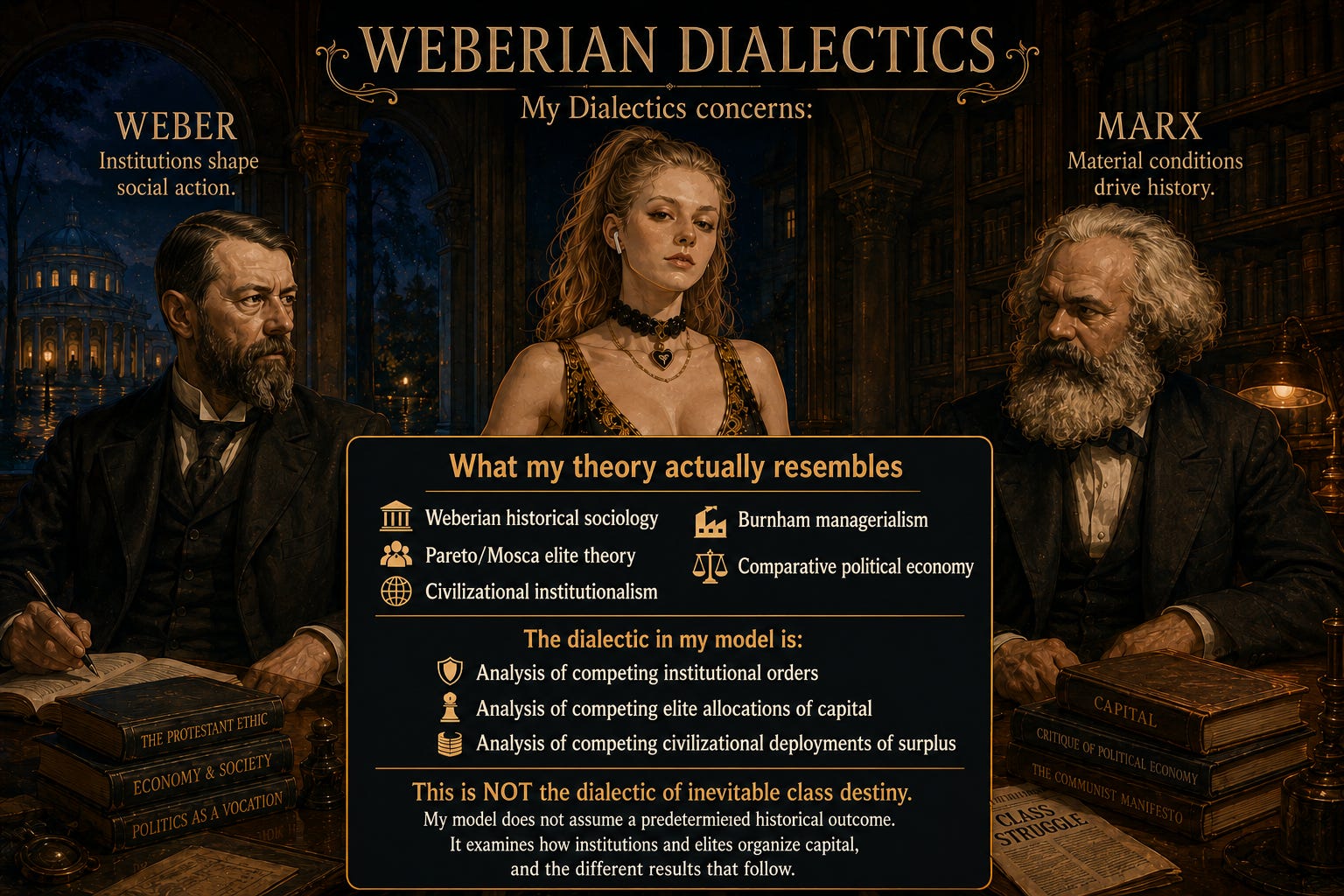
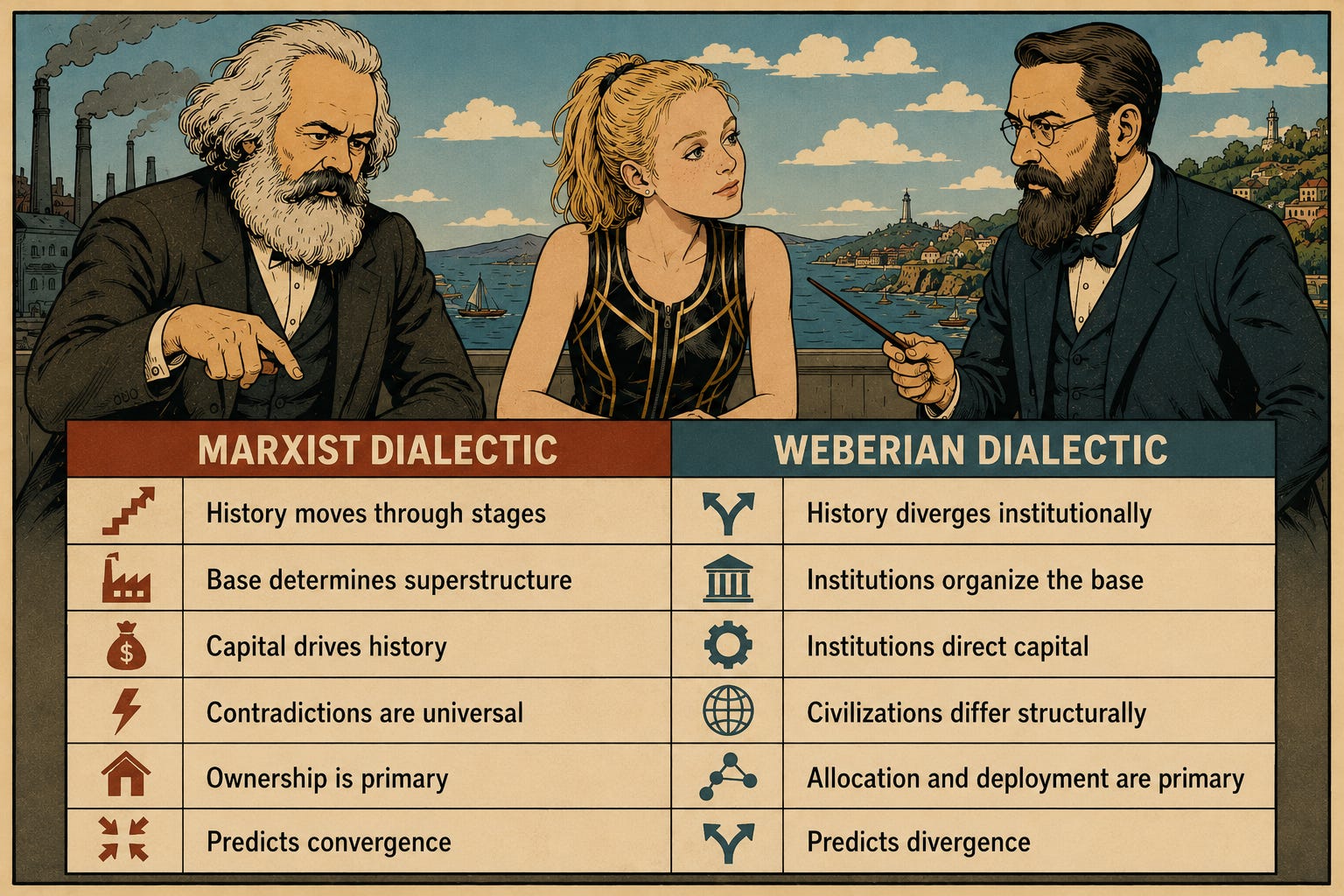
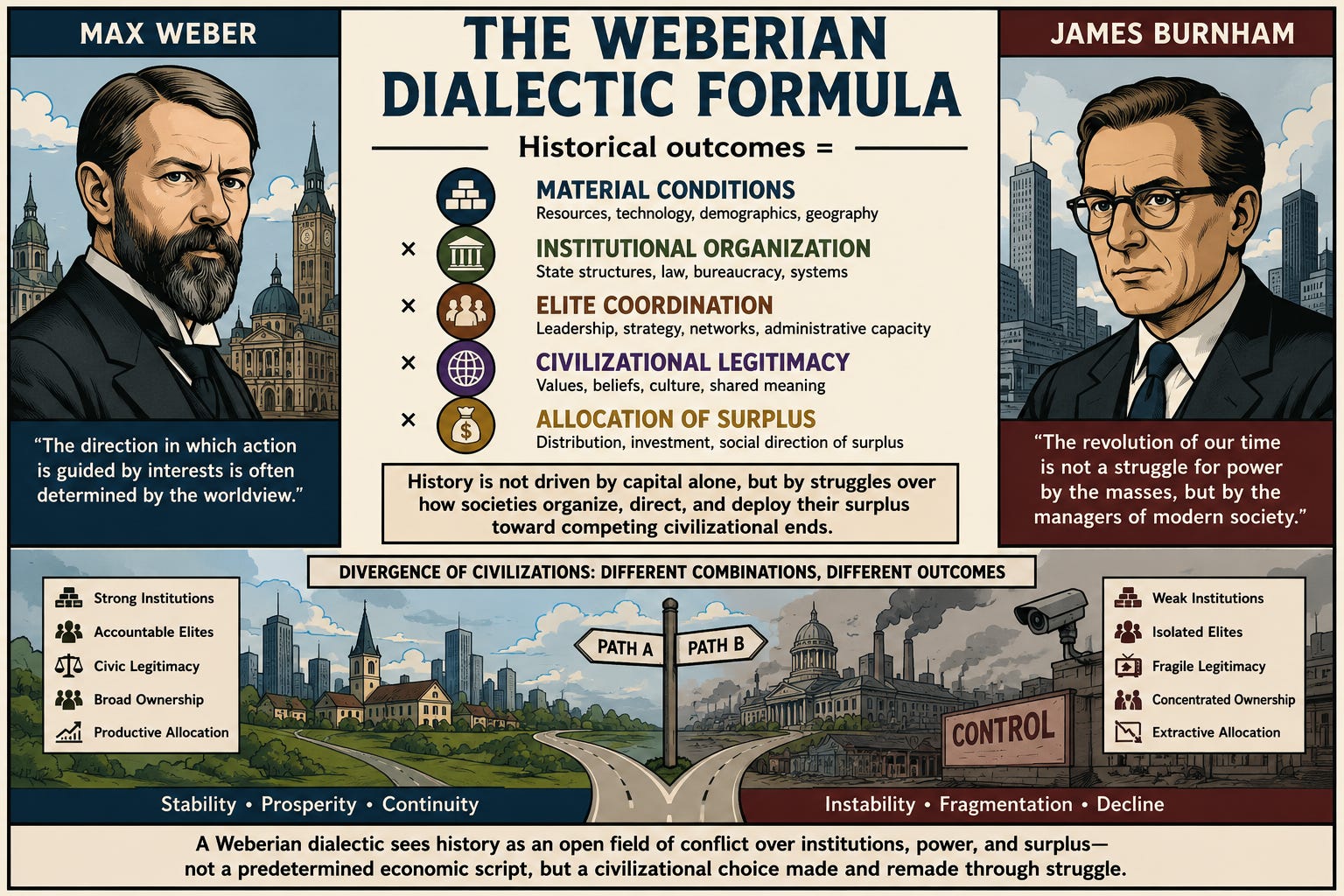
A Weberian Dialectic Theory: History is not driven by capital alone, but by struggles between institutions, classes, and elites over how capital is organized, distributed, subordinated, used and directed toward social ends. Different civilizations can therefore be compared by examining who controls capital, what purposes it serves, and which social groups benefit from its organization. Since institutions/superstructure organize the base itself, we have a right to perform dialects on how those institutions organize the base. This is an inversion of Marxism. The difference between Marx and Weber is not merely academic. It determines whether history is understood as a universal process moving toward convergence, or as a struggle between civilizations whose institutions deploy capital in radically different ways.
THE FAILURE OF UNIVERSAL DIALECTICS
“The direction in which action is guided by interests is often determined by the worldview.”
— Max Weber
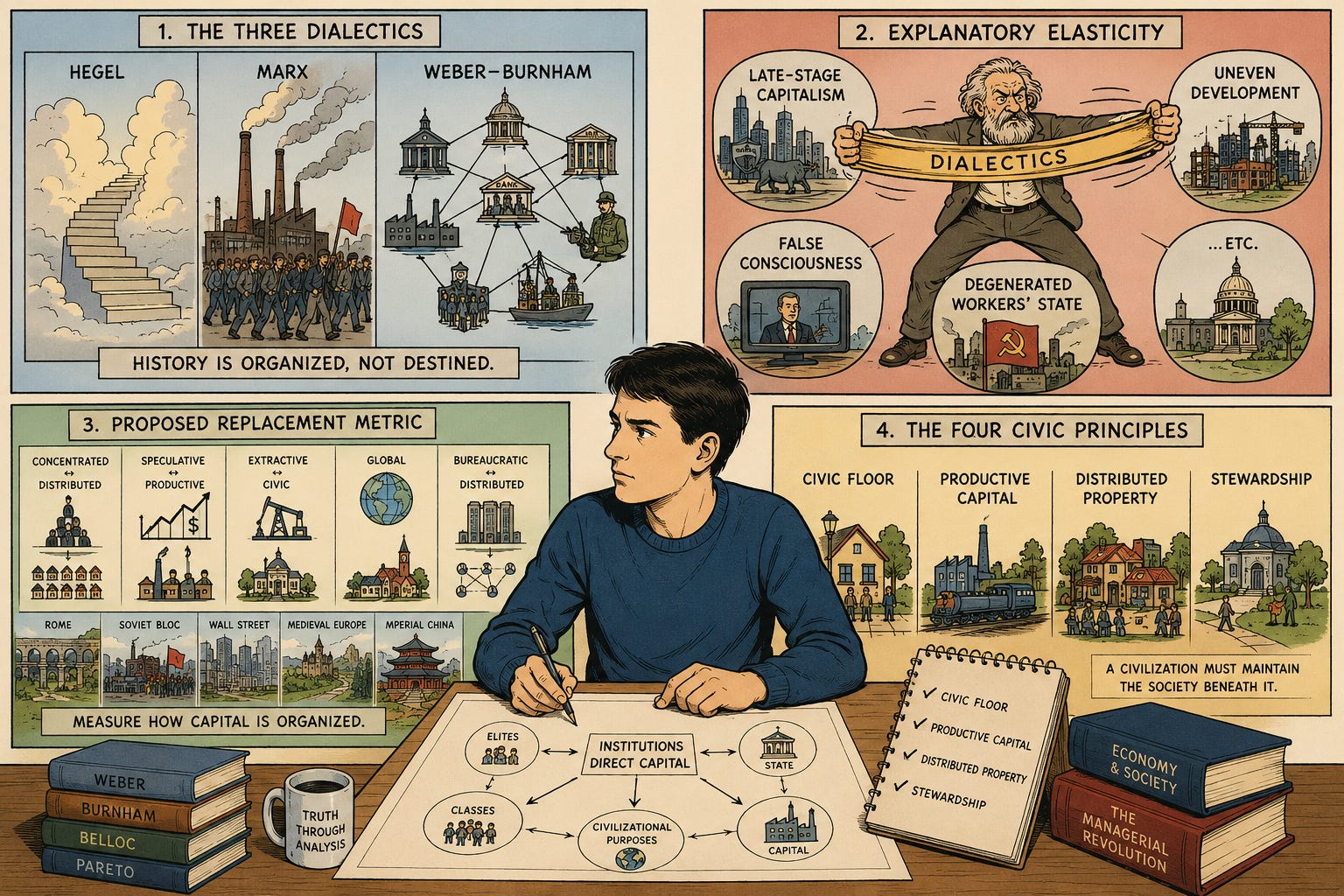
For over a century, dialectical materialism claimed to offer a scientific explanation of history; to those of us who are honest about what we are hearing from the proponents of the Engles view, Marxist dialectics have become mostly useless and frequently tautologically meaningless. One of the deepest problems with the system as developed by Friedrich Engels is its extraordinary elasticity. It becomes so universal that it can absorb almost any historical outcome into itself after the fact; this is a problem, because a theory that you infinitely alter with ideological victory or defeat, becomes not a science but a religious doctrine.
Revolutionary failure, capitalist recovery, nationalist revival, authoritarian persistence, welfare-state expansion, technocratic liberalism, and even the return of oligarchic capitalism in post-Soviet Russia can all be reinterpreted as merely another “dialectical stage” or contradiction unfolding within the process of history. For those of us who are not mired in ideological post hoc rationalizations, this makes ‘dialectical materialism’ a theory which says very little about social change, and even less about capital.
“Dialectical materialism” increasingly resembles a theological language rather than a scientific one. Like the fragmentation of Protestant sects after the Reformation, the Marxist tradition splintered into countless competing vanguard interpretations, Leninists, Trotskyists, Maoists, Eurocommunists, democratic socialists, national communists, Third-Worldists, each claiming to possess the correct reading of the dialectic while often arriving at radically contradictory political conclusions. A theory capable of explaining everything retroactively risks losing its ability to predict anything concretely beforehand.
For example, “uneven development” increasingly functions as a kind of Marxist shibboleth because it allows almost any historical contradiction to be reabsorbed back into the theory after the fact. Capitalism survives? Uneven development. Revolution fails? Uneven development. Nationalism overrides class solidarity? Uneven development. Religious identity proves stronger than material interest? Uneven development. The phrase originally described a real historical phenomenon, societies modernize differently, but it gradually became a conceptual escape hatch capable of explaining nearly every deviation from prediction.
Marxists use “uneven development” as a rescue mechanism. We must accept that history does not move in a straight line, and that uneven development creates a fundamental problem for Marxist theory. If every possible historical outcome can be reclassified after the fact as another “dialectical contradiction,” then the theory loses explanatory sharpness precisely because no outcome can ever truly disprove it.
Yet perhaps the problem is not material analysis itself, but rather the attempt to elevate it into a total metaphysical materialist explanation of history; what if we merely rejected that part of the Marxist project. Material analysis survives Marxism; this is likely the one and only thing I would take from the Marxists. The failure of universal dialectics does not invalidate material inquiry itself; it merely invalidates the claim that history unfolds according to one universal economic destiny.
In the dialectics I suggest we narrow the frame and ask a simpler question: how capital is organized, distributed, subordinated, and socially directed within a civilization. If we just ask that narrow question might we may recover something genuinely measurable about political order. Capital does not act independently. Institutions, bureaucracies, states, elites, and organized classes struggle over capital and direct it toward different ends. History is therefore not merely the movement of capital, but social warfare over the control and purpose of capital itself.
The Three Dialectics
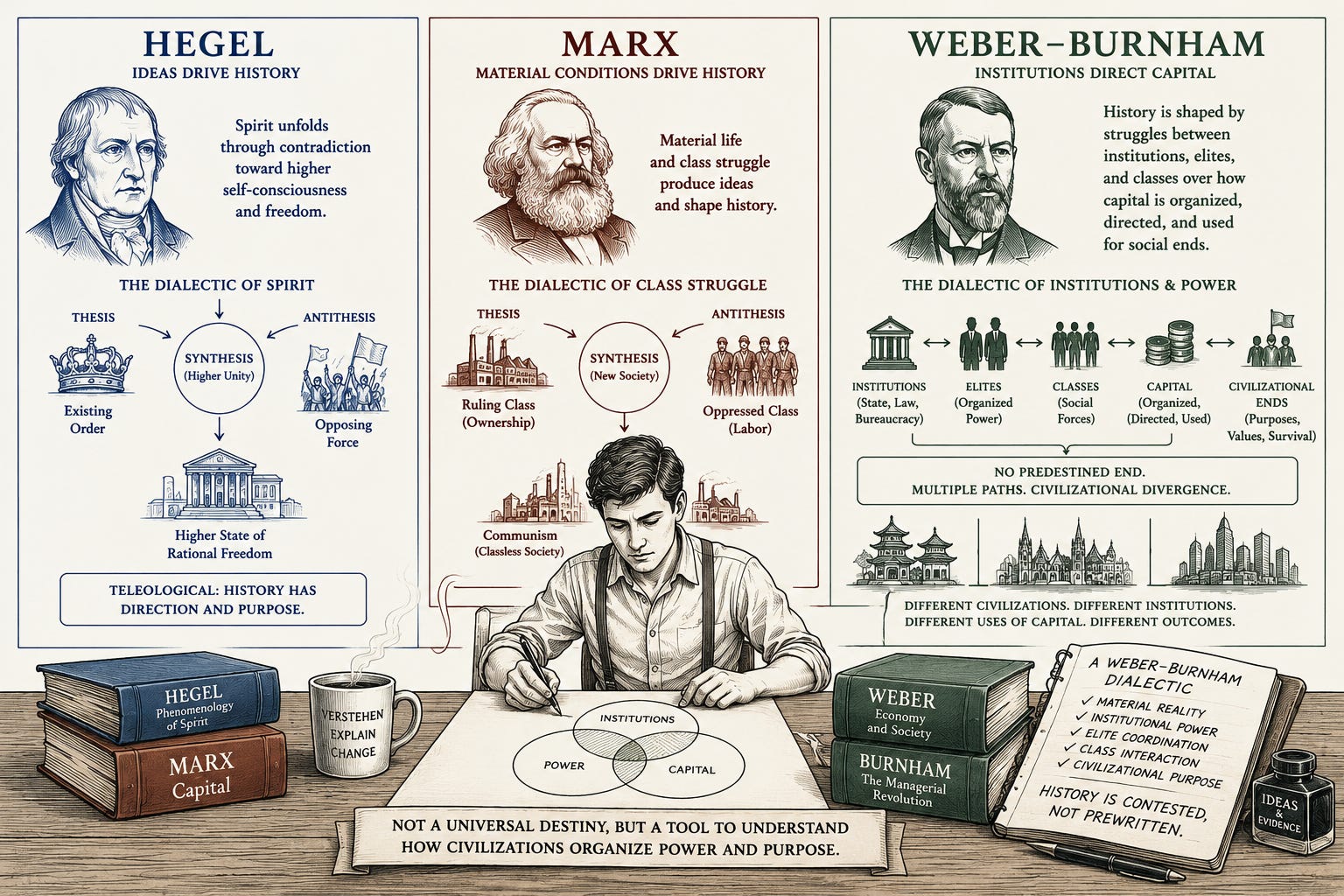
Hegelian Dialectics
Georg Hegel believed, and I think wrongly, that history was a movement of ideas toward progressively higher forms of rational self-consciousness. In simplified form, contradictions within an existing order produced conflict, and that conflict generated a higher synthesis which partially reconciled the previous opposition. History therefore possessed an inner philosophical direction. Spirit unfolded through contradiction. States, religions, civilizations, and institutions were expressions of this deeper movement toward “rational freedom.”
Karl Marx regarded this idealist framework as fundamentally inverted. To Marx, Hegel had placed abstract thought above material life, and that it was material life which was moving towards “rational freedom.” Marx therefore claimed to “turn Hegel on his head” by arguing that material conditions, labor relations, ownership structures, and economic conflict generate the ideological world rather than the reverse. Ideas no longer drove history, but material production did. The dialectic remained, but it became economic rather than spiritual. Class struggle replaced the unfolding of Spirit as the engine of historical transformation, and I think wrongly, could be used to predict one natural inevitable convergence towards communism.
Marxist Dialectics and the Failure of Synthesis
The central problem is that Marxist dialectics increasingly fail to produce any stable synthesis at all. The theory imagines history progressing from A to B to C, feudalism to capitalism to socialism, contradiction producing resolution through higher social organization. However, real history resembles endless cycles of conflict, elite replacement, bureaucratic consolidation, and renewed hierarchy rather than permanent synthesis.
What Marxists frequently describe as “liberation” often becomes merely the downward redistribution of domination onto another social group or the replacement of one ruling structure with another. Aristocracies become party bureaucracies. Bourgeois elites become managerial elites. Dynastic hierarchies become technocratic hierarchies. The rhetoric changes while concentrated institutional power remains.
Rather than moving cleanly from A to B to C, civilizations often produce what might be called endless “C-to-B” reversions: decentralization followed by re-centralization, revolution followed by bureaucracy, reform followed by oligarchy, liberation followed by administrative consolidation. History appears less like a staircase and more like recurring institutional recombination. Marxist dialectics therefore increasingly resemble a language for retroactively rationalizing outcomes rather than a predictive scientific framework capable of identifying genuine historical synthesis.
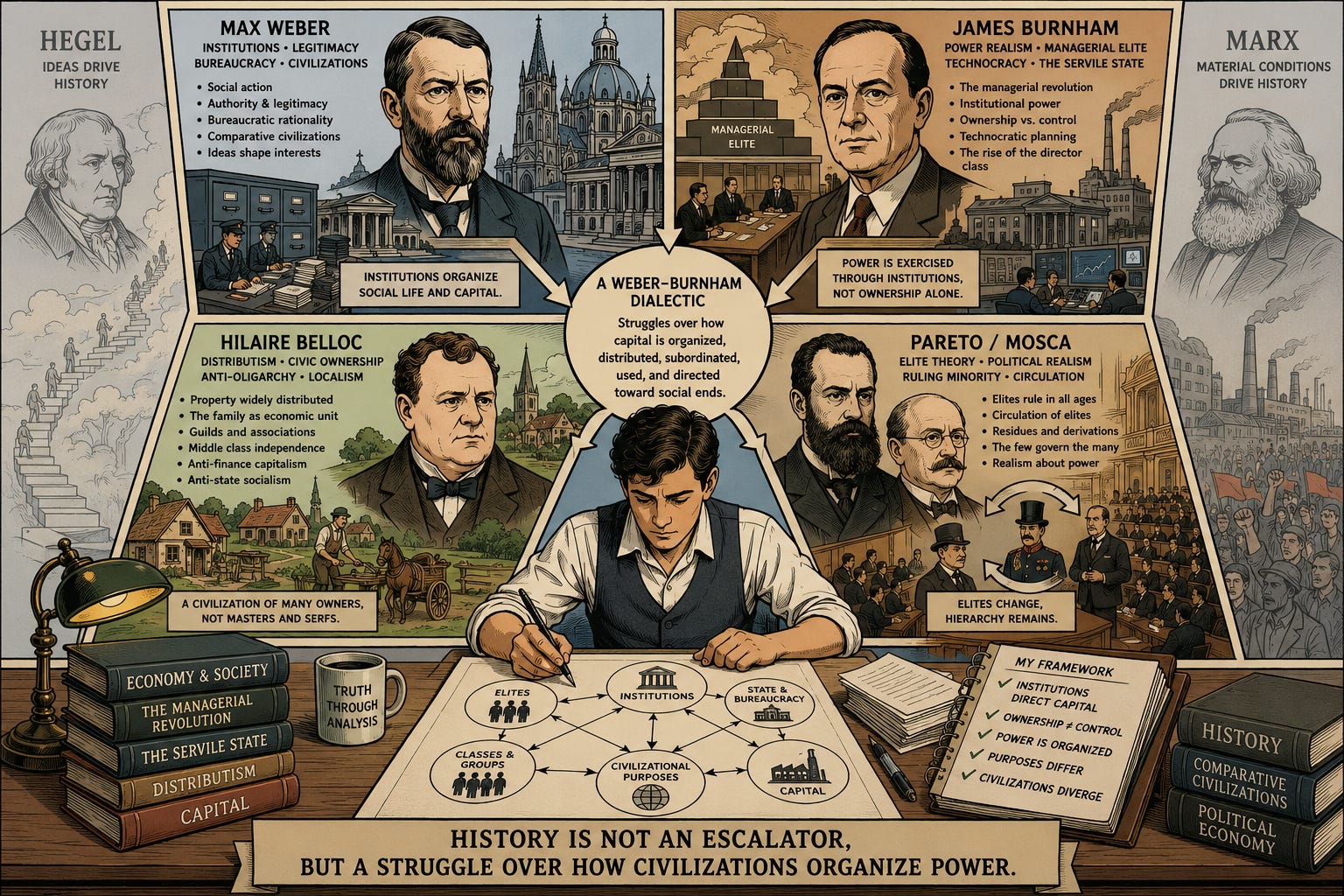
The Weber–Burnham Dialectic
My own framework is not designed to uncover a universal historical destiny or final synthesis. The Weber–Burnham dialectic instead compares how different civilizations organize power materially through institutions. The central question is not who rhetorically “owns” capital, but who directs it, how it is organized, and toward what purposes it is deployed.
A Weberian dialectic therefore examines the interaction between:
material conditions,
institutional organization,
elite coordination,
bureaucratic administration,
and the civilizational allocation of surplus.
History is not driven by capital alone, nor by abstract class destiny, but by struggles between institutions, organized elites, classes, states, and civilizations over how productive power is socially directed. Different societies therefore generate radically different outcomes from similar material conditions because institutions organize surplus differently. History is contested; not pre-written.
Unlike orthodox Marxism, my framework predicts divergence rather than convergence. Civilizations may industrialize, stagnate, centralize, fragment, bureaucratize, financialize, militarize, or decay depending upon how their institutions mobilize and distribute capital across generations. Once dialectics are understood in these competing senses, the central weakness of orthodox Marxism becomes easier to identify: its extraordinary explanatory elasticity.
The Problem of Explanatory Elasticity
The strongest critique of orthodox dialectical materialism is not that material conditions are irrelevant, because I am not saying that, but that Marxist frameworks treat capital as the primary force moving history while dismissing in relevance the independent power of institutions, bureaucracies, states, military systems, and organized elite coalitions. Marx remains valuable insofar as he recognized that material incentives, ownership structures, class tensions, and surplus allocation profoundly shape political life. What must be rejected is not material analysis itself, but the elevation of economic contradiction into a universal and historically deterministic explanation for civilization as such.
Historically, capital repeatedly submits to institutional direction rather than acting freely or automatically. Wartime economies, regimes, central banking systems, sovereign wealth structures, industrial policy, nationalizations, oligarchic patronage networks, and party-controlled economies all demonstrate the same underlying reality: capital is always embedded inside organized structures of power. Even under nominal capitalism, markets are continuously shaped, constrained, redirected, subsidized, regulated, or strategically weaponized by institutions pursuing political and civilizational goals.
For that reason, the central weakness of dialectical materialism is not that it is completely false, but that its explanatory elasticity increasingly weakens its predictive precision. Marxist theory often adapts itself after the fact to radically different outcomes: liberal democracies, Soviet bureaucratic states, Chinese party-capitalism, welfare capitalism, oligarchic systems, and technocratic globalization have all been interpreted as different “stages” or “contradictions” within the same broad framework. A defender can always argue that uneven development, contradiction, adaptation, or transitional phases were already anticipated within the theory itself.
This flexibility creates a problem: A theory that can explain nearly every possible outcome risks losing the ability to clearly predict specific ones. The question therefore becomes narrower and more measurable: not where history is metaphysically destined to move, but how institutions organize, distribute, concentrate, and direct capital within particular civilizations, and whether those arrangements produce stable and flourishing societies beneath their ruling structures.
The Divergence Problem
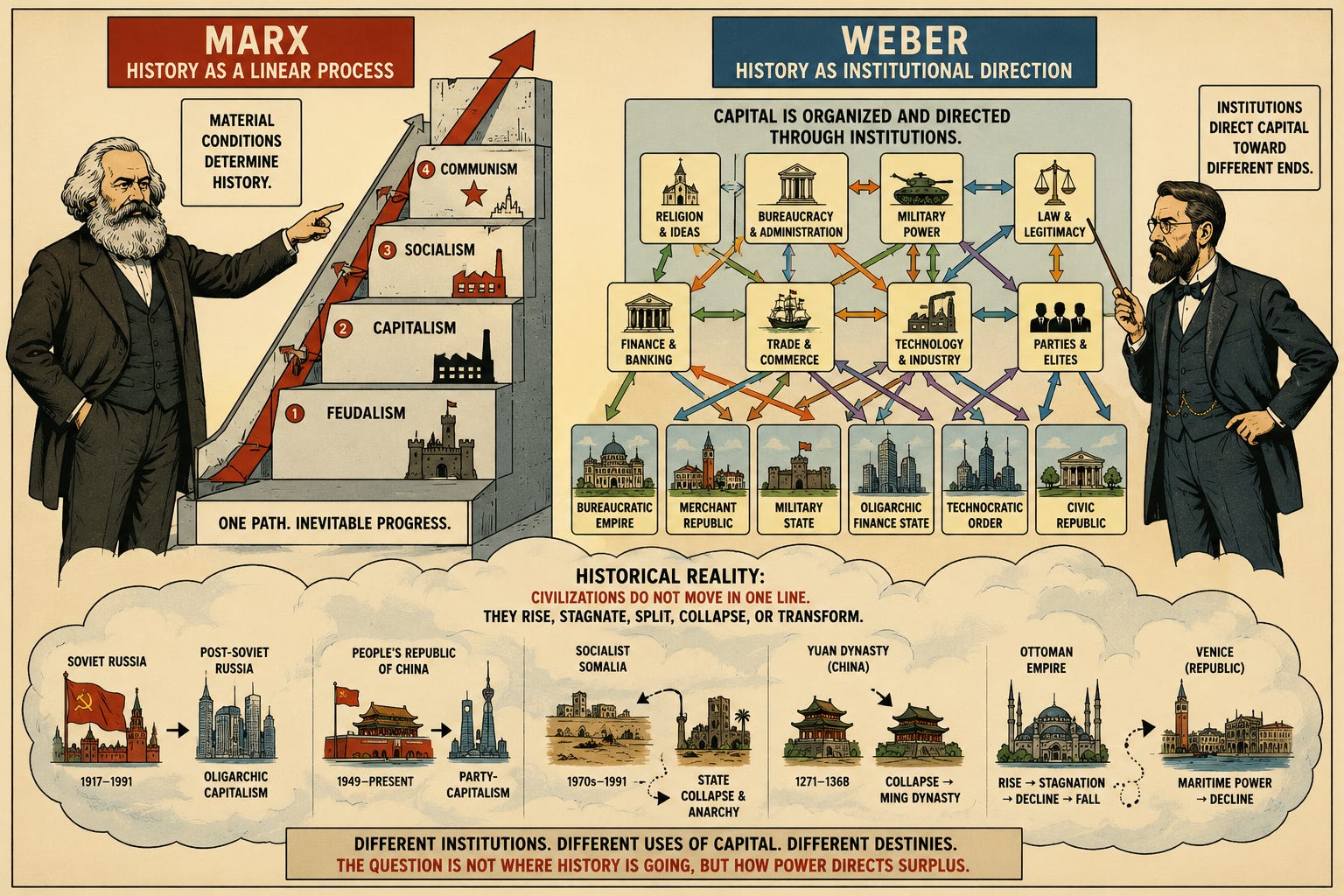
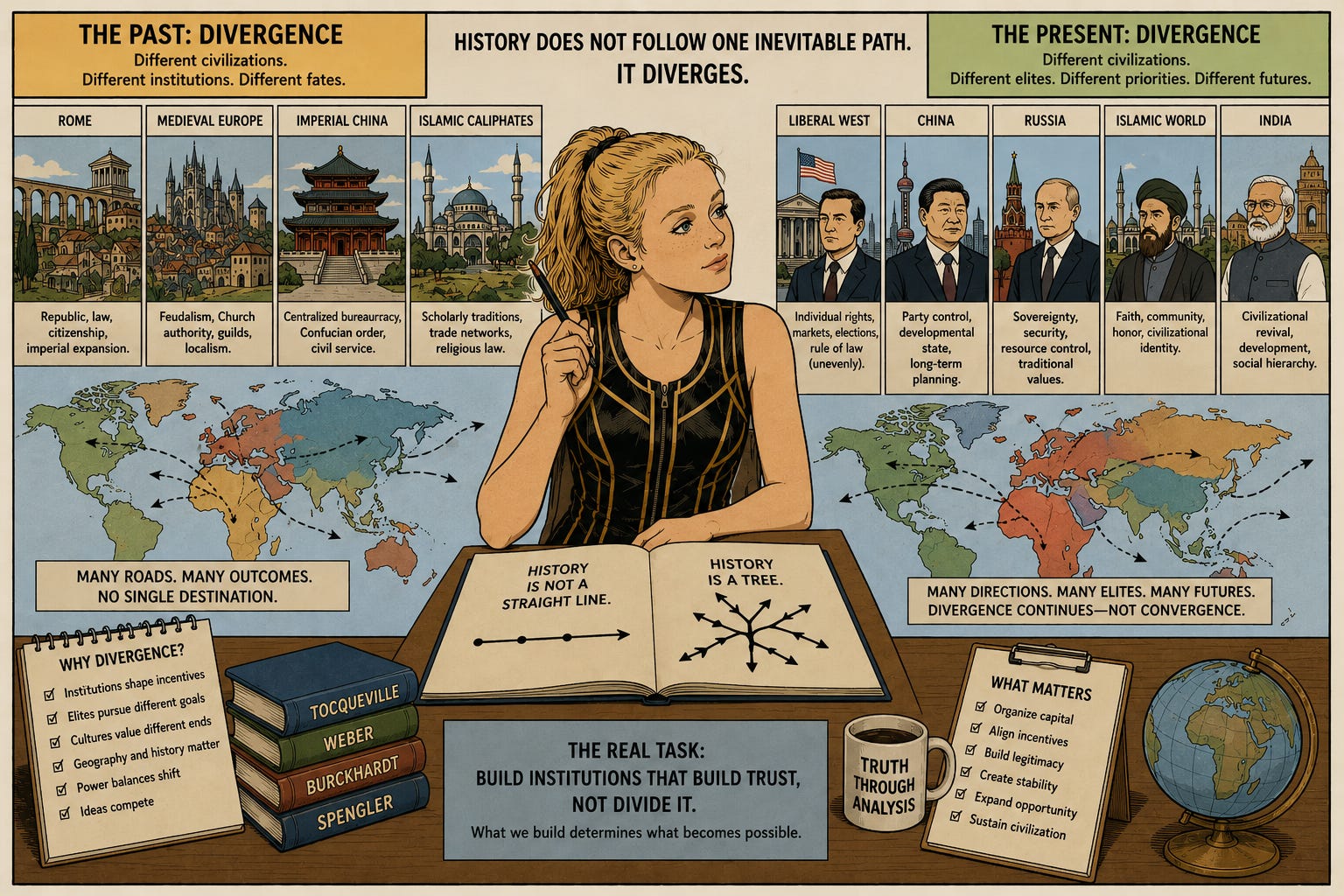
A Weberian dialectic would therefore examine civilizations not as identical societies moving mechanically through predetermined economic stages, but as institutional systems directing capital toward different social ends. Marxist models seem to imply a relatively linear historical progression from feudalism to capitalism and eventually socialism because that sequence roughly reflected aspects of European development; in other words, they saw a pattern in Europe and they thought that applies everywhere, or could apply everywhere. I do not think it does.
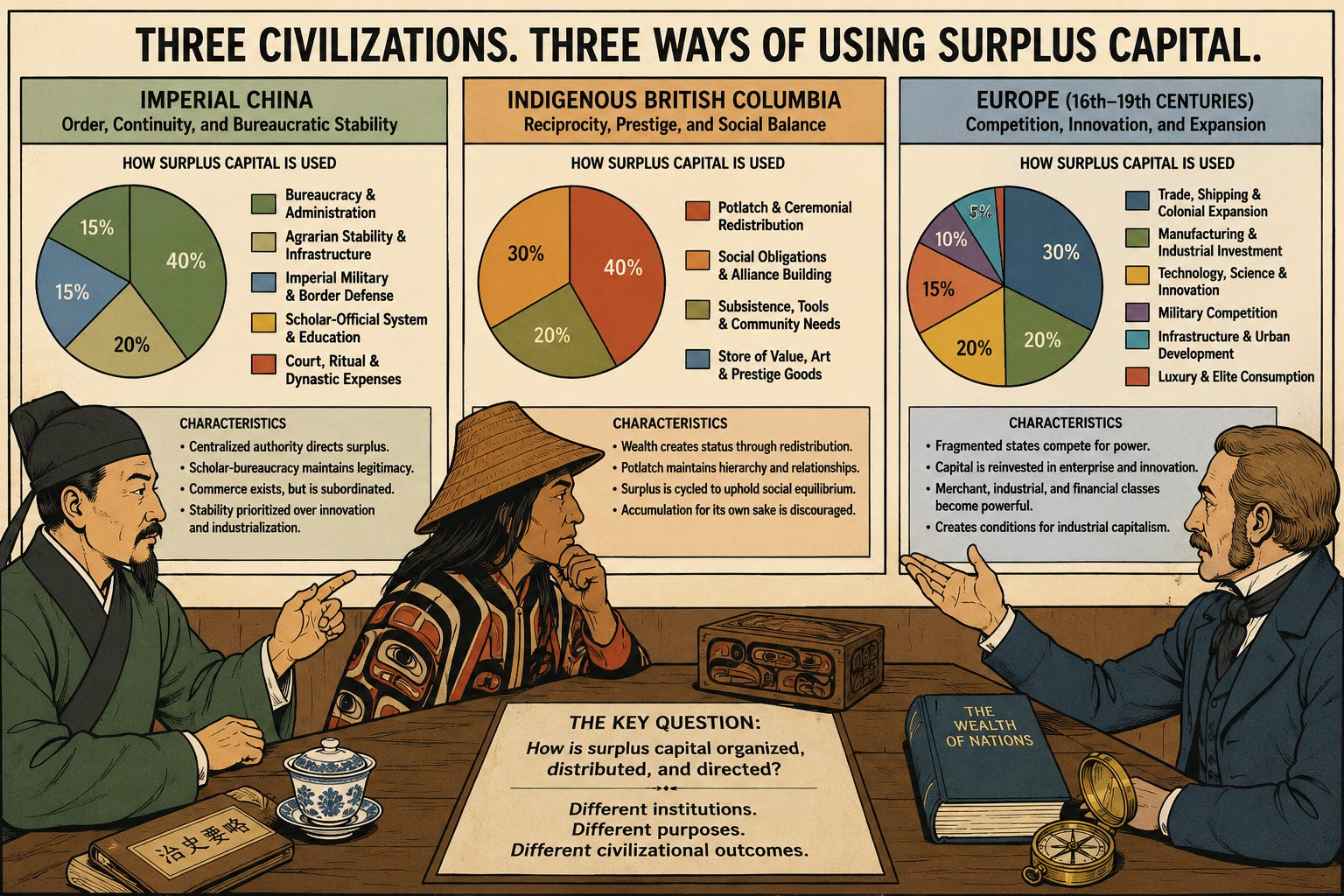
Many civilizations did not follow anything near the European path at all. Imperial China, Mughal India, the Ottoman Empire, and other large pre-modern systems often accumulated enormous wealth and administrative sophistication without developing the same industrial-commercial order that emerged in Europe. The critical question is therefore not simply whether capital existed, but how institutions organized and deployed it. Surplus wealth could be directed toward bureaucracy, court consumption, military maintenance, agrarian stability, religious institutions, or industrial reinvestment.
Different civilizational orders therefore produced different developmental trajectories because they socially directed capital differently. History does not move automatically from A to B to C. Civilizations can centralize, stagnate, fragment, regress, or industrialize depending upon how institutional power organizes surplus and productive capacity. History is not driven by capital alone, but by struggles between institutions, classes, and elites over how capital is organized, distributed, and directed toward social ends. Different civilizations can therefore be compared by examining who controls capital, what purposes it serves, and which social groups benefit from its organization.
Among some Indigenous societies of the Pacific Northwest coast, including groups in what is now British Columbia, wealth and prestige were often reinforced through redistribution, ceremonial gifting, and sometimes even deliberate destruction of surplus goods during “potlatches.” The point was not “economic inefficiency” in a modern capitalist sense, but the maintenance of hierarchy, legitimacy, reciprocity, alliance systems, and social equilibrium. In Weberian terms, capital was being socially directed toward status order and communal legitimacy rather than indefinite productive accumulation. That demonstrates that surplus wealth does not automatically convert itself into industrial reinvestment or capitalist expansion; history does not follow one clear simple Marxist straight line. Institutions and cultural systems determine what surplus is for.
The Polynesian and Hawaiian example works similarly. Polynesia and the Kingdom of Hawaii possessed highly sophisticated social systems adapted to island ecologies, kinship hierarchies, maritime subsistence, ritual legitimacy, and chiefly redistribution. Their “capital,” was embedded in:
land control,
fishing systems,
navigational knowledge,
tribute structures,
labor coordination,
and sacred-political authority.
They could not simply “jump” into English-style agricultural capitalism because economic systems emerge from deep institutional and ecological structures accumulated over centuries. English agriculture itself depended upon:
private property traditions,
enclosure systems,
animal domestication patterns,
legal contracts,
market towns,
banking systems,
maritime trade,
mechanization,
and competitive state pressures.
Europe’s development was not simply the result of “capitalism” appearing, but of a very specific civilizational superstructure that shaped how elites used surplus wealth. European legal traditions surrounding property, contracts, inheritance, municipal autonomy, and corporate rights gradually created protected spaces where merchant, industrial, and financial capital could accumulate outside direct dynastic absorption. Christianity itself, despite often restraining commerce morally, also contributed to the development of universities, literate bureaucracies, canon law traditions, and transnational institutional networks that helped standardize administration and contracts across fragmented political systems. Meanwhile Europe’s constant interstate competition forced rulers and merchants into continuous military, naval, commercial, and technological reinvestment in order to survive against rival powers.
This differed sharply from many imperial civilizations whose institutions often prioritized stability, continuity, ritual legitimacy, centralized administration, or social equilibrium over decentralized productive expansion. In Imperial China, surplus was repeatedly redirected back into bureaucratic order, examination systems, dynastic continuity, and agrarian stabilization. Among many Indigenous societies of the Pacific Northwest, surplus wealth in potlatch systems reinforced legitimacy, reciprocity, alliance structures, and communal equilibrium through ceremonial destruction. Polynesian and Hawaiian systems similarly embedded wealth within kinship, ritual authority, maritime subsistence, and chiefly redistribution rather than competitive industrial reinvestment. None of these systems were “irrational”; they were directing surplus toward different civilizational goals. A Weberian dialectic therefore asks not whether wealth exists, but what institutions believed wealth was for.
Europe’s Unusual Development
What Marx and Engels observed in Europe was not the universal pattern of history, but a highly unusual civilizational trajectory produced by Europe’s distinctive institutional fragmentation and allocation of capital. Unlike many large centralized empires, Europe remained divided among competing kingdoms, merchant cities, aristocracies, churches, banking networks, guilds, and military powers for centuries; it was more individualistic and less despotic. No single bureaucracy fully absorbed or froze economic life, as in most other civilizational spaces.
Capital therefore increasingly escaped purely dynastic consumption and began flowing into maritime expansion, commercial competition, industrial production, scientific instrumentation, military innovation, and banking systems. Europe’s political instability, paradoxically, generated extraordinary economic dynamism because competing states and elites were forced into continuous reinvestment, innovation, and expansion in order to survive against one another.
This differed sharply from many other civilizations whose surplus wealth was often directed primarily toward imperial administration, court hierarchy, agrarian stabilization, dynastic continuity, ritual prestige, or centralized bureaucratic maintenance. Imperial China, the Ottoman Empire, Mughal India, and Safavid Persia all possessed immense wealth, administration, and urban life. Yet their institutions frequently redirected economic energy back into the preservation of political power itself.
Commercial classes existed, but they were often subordinated beneath imperial bureaucracies, palace systems, military-administrative structures, or hereditary aristocracies that prevented capital from evolving into an increasingly autonomous engine of industrial transformation. These civilizations did not simply “fail” to become Europe. Rather, they organized and socially directed surplus in ways which caused their own power entrenchment and stagnation.
A Weberian dialectic would therefore argue that Europe unintentionally misled later Marxists into believing that history itself naturally “progresses” to a necessary better and better world, through fixed stages: feudalism, capitalism, socialism, and beyond. Many civilizations did not move in a straight line from A to B to C. Most by contrast, seem to repeatedly centralize and decentralize; others cycled between bureaucratic consolidation and fragmentation, or between commercial expansion and imperial reabsorption. In many cases, surplus capital was directed toward maintaining stability rather than accelerating transformation. Europe’s path was therefore historically exceptional rather than universally predictive. The decisive question is not whether capital exists, but how institutions organize, deploy, constrain, distribute, and reinvest it within a civilization.
Europe was unusual not because it possessed “capital” alone, but because no single institution successfully froze or monopolized all competing power centers for very long. Kings competed against nobles, nobles against merchant cities, merchant cities against churches, churches against monarchies, guilds against aristocracies, and later industrial interests against landed elites. This continual institutional fragmentation prevented the complete political freezing of economic life into one stable imperial hierarchy.
In other societies, surplus wealth was deliberately constrained, redistributed, ritualized, or even symbolically destroyed, as in the case of North America; something the Marxists themselves would hardly approve of, anymore than Liberals would. In many other civilizations, powerful centralized bureaucracies repeatedly reabsorbed commercial classes back into administrative structures oriented primarily toward dynastic continuity, agrarian stabilization, or imperial maintenance.
European mechanisms for capital deployment made a huge difference to the things which Marxists self-deceived themselves into believing to be some sort of inevitable universal progressive advancement. Marxism often papers over this institutional specificity by treating Europe’s experience as though it revealed a universal law of historical development rather than a highly contingent civilizational configuration. It is not, that history is moving towards “progress.” It is just that Europeans, did things, differently.
Weberian Dialectics
Weberian dialectics must treat history not as a universal economic sequence, but as a struggle between institutions, elites, civilizations, and classes over how surplus and capital are organized. Material conditions still matter, but they are always mediated through institutional power, legitimacy, administration, and civilizational priorities, and these differ drastically without any evidence for direction or convergence.
A Weberian dialectic therefore rejects the idea that capital acts in history or possesses a universal historical destiny. Capital is never socially neutral, but rather, human institutions organize it, weaponize it, constrain it, distribute it, and direct it toward different civilizational purposes. The real material question is therefore not whether a society calls itself capitalist, socialist, communist, feudal, or democratic, but how surplus is actually mobilized within the institutional structure of that civilization.
Does capital become concentrated or broadly distributed?
Is it directed toward productive industry, speculative finance, military extraction, bureaucratic maintenance, technological innovation, public infrastructure, dynastic consumption, or civic stability?
Does technological development diffuse ownership downward into society, or merely intensify managerial and financial concentration at the top?
These are measurable Weberian questions because they examine the actual social organization and deployment of material power rather than appealing to abstract historical destiny.
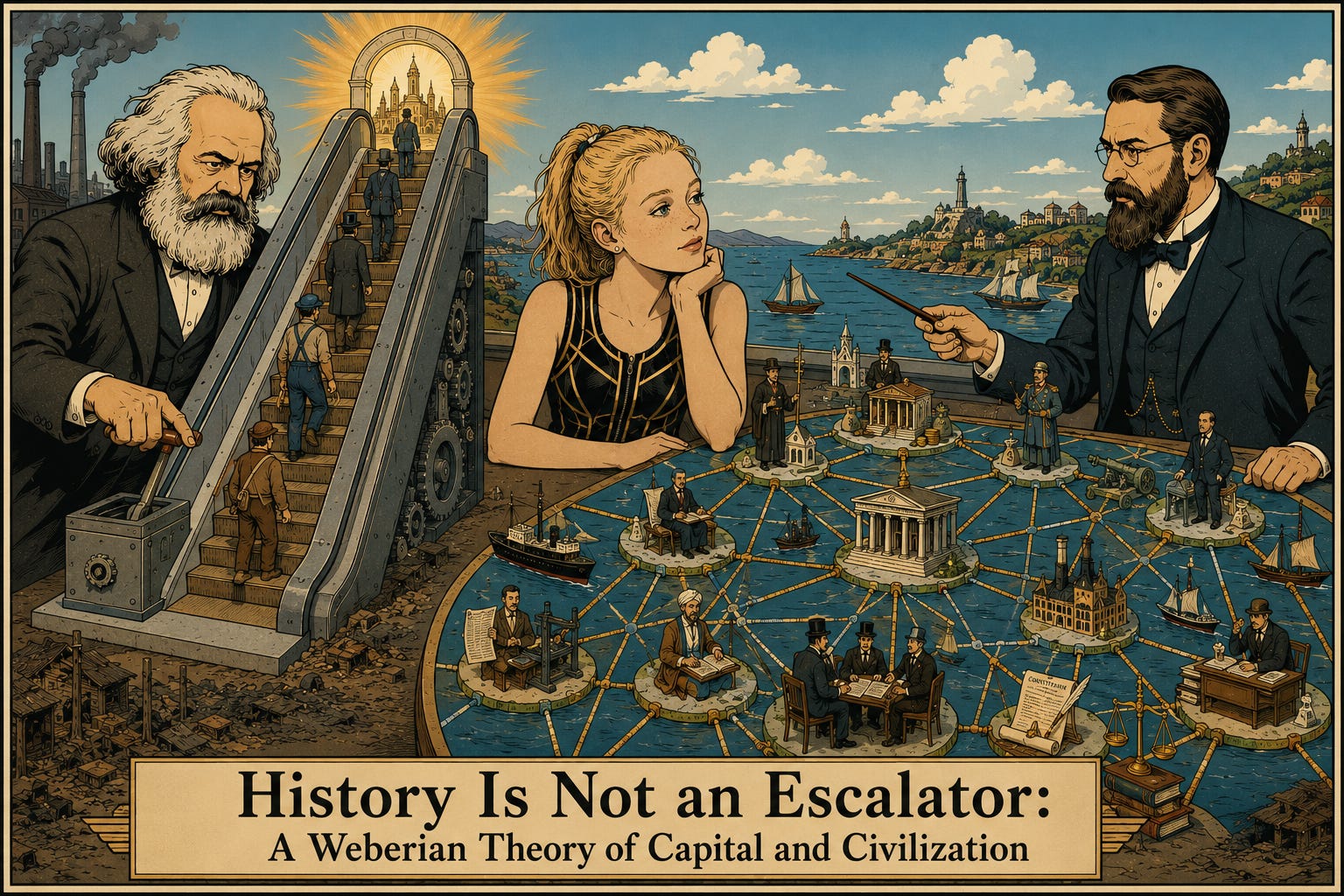
Under this framework, history ceases to resemble a universal escalator moving societies automatically from one stage into another. Civilizations can industrialize, stagnate, centralize, fragment, regress, militarize, bureaucratize, or technologically accelerate depending upon how their institutions organize surplus and direct capital over time. A
Weberian dialectic is therefore anti-Marxist precisely because it rejects the notion that material history unfolds according to inevitable universal laws. Instead, it treats civilizations as competing institutional orders whose developmental outcomes depend upon how human beings organize, distribute, deploy, and legitimize capital within particular historical and cultural systems.
My formulation differs from orthodox Marxism because I am arguing:
Capital is not historically autonomous.
Classes are mediated through institutions.
Bureaucracies and organized elites can dominate both labor and capital.
Civilizations differ by how they socially direct surplus and productive power.
The Weber–Burnham dialectic replaces the Marxist focus on ownership with a focus on institutional control over capital and social organization.
The Weberian Dialectic Formula
Historical outcomes =
Material conditions
× institutional organization
× elite coordination
× civilizational legitimacy
× allocation of surplus.Under this framework, history is not driven by capital alone, but by struggles over how institutions organize, distribute, legitimize, weaponize, and deploy capital toward competing ends.
“According to the materialist conception of history, the ultimately determining element in history is the production and reproduction of real life. More than this neither Marx nor I have ever asserted.”
— Friedrich Engels, Letter to Joseph Bloch (1890)
The Inversion of Marxism
Marxism treats the institutional “superstructure” of culture, law, bureaucracy, religion, administration, legitimacy, and political order, as largely downstream from the economic base. I think this is the mistake.
A Weberian dialectic reverses this relationship. Institutions are not passive reflections of capital; they organize capital, constrain it, weaponize it, distribute it, legitimize it, and direct it toward particular civilizational purposes. The same material wealth can produce radically different societies depending upon the institutional order governing it.
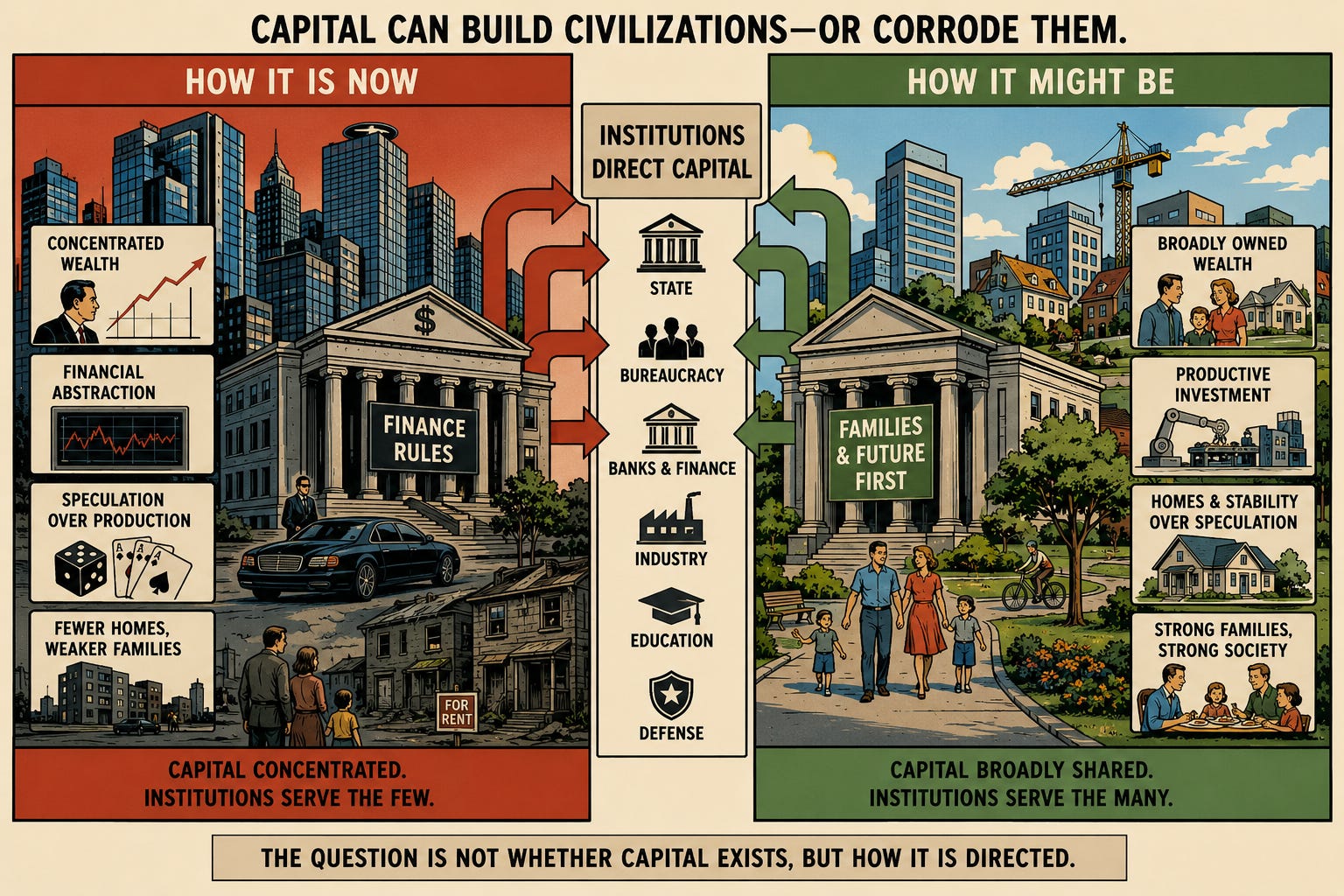
One civilization may direct surplus toward family formation, infrastructure, productive reinvestment, and civic continuity, while another channels it into speculation, bureaucratic expansion, elite insulation, surveillance, or dynastic preservation. The decisive force in history is therefore not capital alone, but the institutional structures and elite coalitions that command its movement.
I am NOT rejecting material analysis. I am rejecting, material determinism because I see it as incoherent, historical inevitability, because I see history as contradicting this notion, with the exception of the trick of Europe, which blinded Marx, and the autonomy of capital, because I see that as disproved by how different elites and institutions treat human life very differently in different civilizations. A Weberian dialectic applies material analysis not to the destiny of history itself, but to the institutional organization, concentration, and civilizational deployment of capital.
Marxism says that societies broadly move through similar developmental stages because economic contradictions operate universally. A Weberian dialectic instead predicts divergence: different institutional orders direct surplus toward different ends and therefore produce radically different historical trajectories from similar material conditions.

Institutions Are Not Merely Class Instruments
“The state is a product and a manifestation of the irreconcilability of class antagonisms.”
— Vladimir Lenin, State and Revolution
Lenin’s critique of liberal institutions was not entirely irrational within the context of nineteenth and early twentieth century Europe. Courts, police systems, parliaments, property law, and state bureaucracies often do function heavily in defense of established classes and property relations. Marxists were therefore correct to recognize that institutions are never perfectly neutral abstractions floating outside history; this I am perfectly happy to grant them. I merely think that this method of thinking tends towards a horribly vulgar and simple conception; the idea that the judge, the lawyer and the rich criminal are always on the same side. Reality is not that simple. Institutions emerge within struggles over legitimacy, power, wealth, and social order. Law itself reflects the priorities of civilizations and the coalitions that govern them, and can be both poorly used, and well used. Institutions can corrode trust and build trust, and these are two different things.
It does not follow that institutions are therefore merely identical instruments of class domination reducible entirely to economic ownership, as Lenin thought. ( Even as sympathetic as I might be to that accusation, it is the accusation of both the rightly accused and condemned, as well as the wrongly accused and condemned. ) Different institutional systems demonstrably constrain power differently, distribute opportunity differently, organize capital differently, and produce radically different civic outcomes over time. Institutions can restrain oligarchic behavior, regulate wealth, diffuse ownership, prosecute corruption, stabilize social trust, and even partially subordinate powerful economic actors to broader civic priorities. Wealthy elites themselves are often displaced, expropriated, imprisoned, regulated, or subordinated by institutional systems stronger than any single individual actor operating within them.
Modern societies increasingly demonstrate that institutions frequently pursue goals which cannot be reduced neatly to simple class interest at all. In the contemporary United States, for example, many major institutions, universities, bureaucracies, media systems, corporations, and administrative structures often allocate resources, opportunities, symbolic prestige, legal protections, and political attention according to ethnic, racial, managerial, ideological, or bureaucratic priorities which do not align directly with the immediate interests of large portions of the working class, including many poor and lower-middle-class Whites. Likewise in Canada, institutional structures surrounding First Nations policy, legal recognition, land claims, and administrative governance often operate according to historical, treaty-based, constitutional, or legitimacy frameworks that cannot be explained through classical proletarian-versus-bourgeois categories. ( The Marxists ignore this to their own rhetorical and organization peril. ) Whether one agrees or disagrees with these institutional priorities politically is secondary to the analytical point: institutions clearly possess partially autonomous organizing logic beyond simple ownership relations alone.
This is exactly why a Weberian dialectic becomes necessary when contrasted against how institutionalized and accepted Marxism fails to break through and conquer the Leftist eco-chambers, despite being well-understood by academic institutions for decades now. Institutions are not perfectly neutral, but neither are they merely theatrical masks worn by economic classes. Institutions possess varying degrees of autonomy, legitimacy, continuity, administrative logic, and power over the organization of surplus itself. The real historical question is therefore not whether institutions exist outside power, because they do not, but whether particular institutional systems successfully restrain predatory extraction, maintain civic continuity, diffuse prosperity broadly enough to sustain legitimacy, and organize capital toward long-term civilizational stability rather than toward narrow elite insulation alone. That should be our contrast and our dialectic, articulated clearly; is trust being built across the board, or destroyed. I am not defending liberal neutrality naïvely, I am not denying class power; I am merely illustrating why the common reductionism of the Leftist “class-based” accusation, is refuted even by the many institutions which they themselves dominate.
From Analysis to Prescription
The Weber–Burnham dialectic is primarily an analytical framework rather than a complete political ideology. Its purpose is not to dictate one inevitable moral system, but to provide a narrower and more measurable method for examining how civilizations organize capital, institutions, legitimacy, and surplus.
The sections which follow should therefore be understood not as automatic deductions from the dialectic itself, but as my own proposed civic preferences derived from applying that framework to modern conditions. Different readers could potentially accept the analytical framework while arriving at different political conclusions.
The dialectic itself merely asks:
how is capital organized,
who directs it,
through what institutions,
toward what ends,
and with what civilizational consequences?
My own “Three Turns” and “Four Civic Principles” represent one possible normative response to those observations rather than the dialectic in its pure analytical form; in other words, given what we know, this would be my own “ideological design recipe solution, for how to alter the current allocation of capital. A blueprint that well-could include plans for the induction of capital to different social ends. My plan would be neither Soviet nor purely National Socialist or Party-directed Capital as with China, but something to be tailor made to the society we find ourselves in. If conditions are worse than any of the others in one area of capital allocation, that is what we would adjust in order to spread wealth to the civic polity.
TURN ONE — What actually changes
Every civilization eventually develops a language through which it understands social order. Medieval Europe famously divided society into the “Three Orders”: those who pray, those who fight, and those who work. This structure itself evolved out of older Roman distinctions between patricians, plebeians, military elites, provincial administrators, and landed aristocracy. Although imperfect, these systems represented attempts to explain how power, duty, labor, and legitimacy were distributed within society.
Modernity dissolved older organic social distinctions and replaced them with increasingly economic ones. Liberal capitalism viewed society largely through the categories of consumers, producers, and owners, while Marxism reduced history to the conflict between bourgeoisie and proletariat because those were the dominant industrial classes visible in the nineteenth century. But the modern system has since transformed past that once developing extreme. Now we have extensive bureaucracies, managerial elites, technocratic institutions, media systems, and administrative structures now wield enormous power beyond simple ownership relations, even as much Leftist rhetoric remains trapped in the language of the early industrial age.
Yet both systems increasingly fail to describe the actual complexity of modern civilization. A financial speculator, an industrial engineer, a hedge-fund manager, a state technocrat, and a factory owner may all belong nominally to “capital,” while possessing radically different relationships to production, national continuity, civic stability, and social obligation. The older class models therefore no longer sufficiently describe the true fault lines of modern societies.
TURN TWO — The Broken Social Contract to a New One
The real divide in advanced societies is not merely between “rich” and “poor,” nor between “worker” and “owner,” but between different forms of capital and the social purposes toward which they are directed. Some forms of capital are productive, constructive, and civilizational, and are effectively maintained even when the government claims to own everything. Even when they cannot manage everything productively. These forms of productive capital are actually used to ends that can spread wealth, apart from the intentions of government allocation: industrial capital, logistical capital, managerial capital, infrastructural investment and long-term national enterprise, are all things that benefit from both a market and from government.
Meanwhile the other forms of capital, become increasingly abstracted from civic obligation. These are the problematic uses, where we might look more closely and critically at for how they constrain productive capital and its uses; speculative finance capital, purely technocratic administrative systems, detached algorithmic wealth extraction and transnational rent-seeking structures, are all things that we might take a closer look at. The question is therefore not whether wealth exists, but whether wealth remains socially embedded inside the long-term continuity of a civilization.
A healthy society spreads ownership broadly enough that ordinary citizens possess a material stake in social continuity itself. A civilization where permanent ownership collapses into rent dependency gradually recreates feudal relations beneath modern rhetoric. Homeownership, inheritance, small enterprise, and stable civic belonging are not merely economic preferences; they are anti-oligarchic stabilizers that diffuse power downward into society.
Likewise, the legitimacy of elites depends upon whether rising wealth also produces a rising civic floor beneath the population: infrastructure, wages, public beauty, family formation, stability, public works, and upward mobility. When wealth becomes detached from civic stewardship, legitimacy erodes regardless of ideology.
This problem did not disappear under Communist systems. Under the Soviets, the nomenklatura and apparatchiks formed a tiny administrative and political elite that controlled access to housing, education, privilege, and material security despite the rhetoric of class abolition. Modern China maintains a highly concentrated hierarchy in which billionaire wealth exists largely through Party permission, patronage, and incorporation into the state structure itself.
These billionaires are not fully independent capitalists in the classical liberal sense, but elites permitted, protected, elevated, and sometimes removed by the Communist Party according to political loyalty and state priorities. Yet in both liberal-capitalist and Communist systems alike, the commanding elite remains a very small portion of society, often close to 2% of the population exercising disproportionate institutional, financial, and administrative power over the remaining majority.
One could argue that this contradicts the older promises of both Marxist Communism and earlier idealist socialism, which envisioned not merely new rulers, but the reduction of extreme hierarchical concentration itself. A healthier social contract for modern elites may therefore depend less on abolishing hierarchy entirely than on demonstrating that concentrated capital genuinely produces broad civilizational flourishing beneath it: rising wages, stable families, beautiful public spaces, affordable living, functioning infrastructure, and expanding civic dignity for the majority population rather than merely extraordinary accumulation at the summit.
TURN THREE — THE FOUR CIVIC PRINCIPLES
If societies are to be judged materially at all, if our judgment is to mean anything, prior too and apart from ideology, it might serve us to be honest, direct and clear about what precisely we are “materially judging” when we apply any kind of dialectics to “the material.” We cannot derive any value from the Dialectics of the Marxist-Leninists when we see it clearly being used to justify anything after the fact, and even changing radically based on what the declaration of this or that party says. Material things should be judged very narrowly; they should not be judged according to GDP, market abstraction, or ideological self-description, but according to how capital is socially organized, how it spreads, how it is used, why it is concentrated, how it could be effectively distributed to the widest number of people of sufficient education to benefit from it. This would be a more clarifying and to the point method of using it.
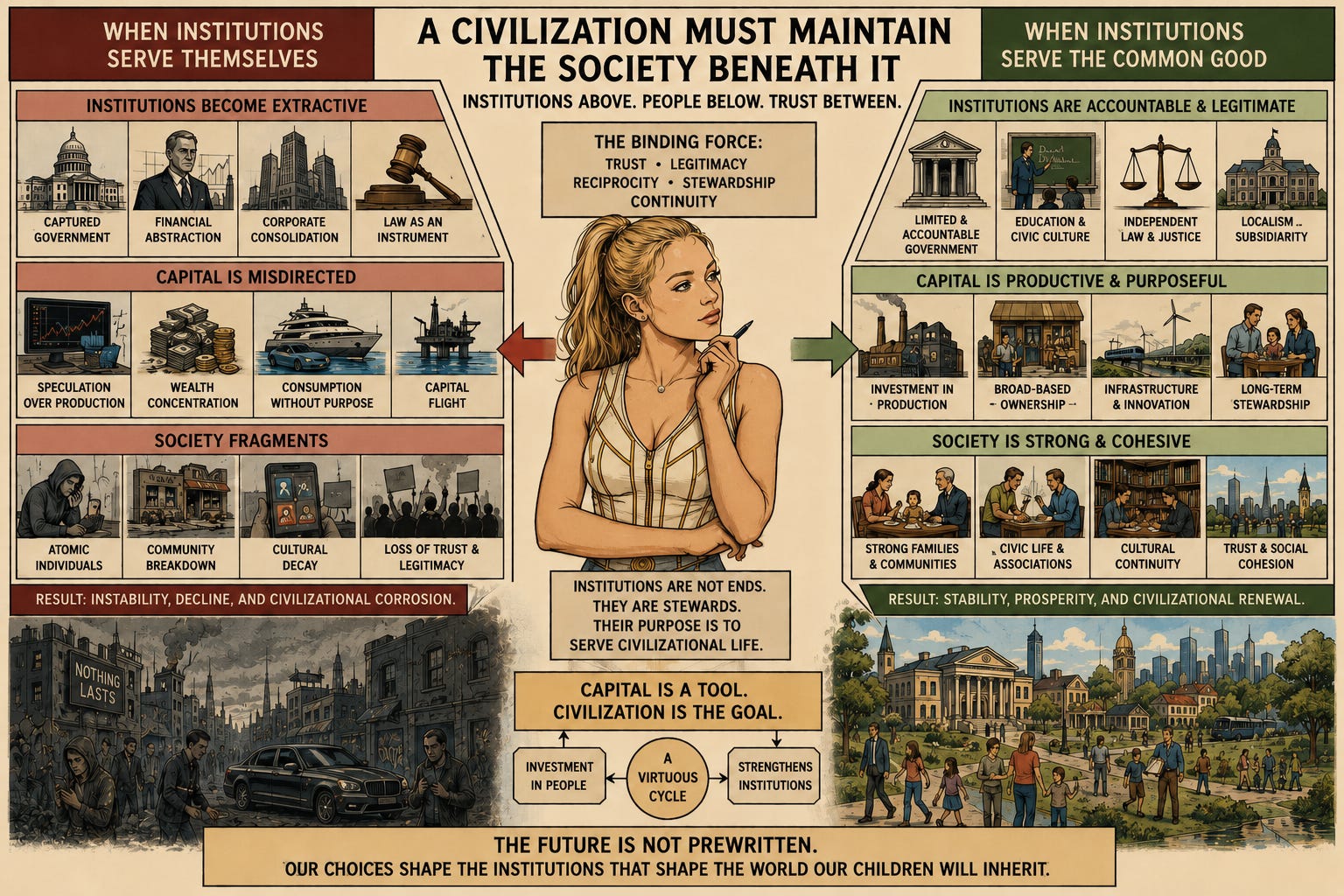
I would suggest that a healthier civilization would therefore rest upon four principles.
1. The Civic Floor Principle
The legitimacy of wealth depends upon maintaining a rising civic floor beneath the population. Economic growth that produces luxury for elites while dissolving stability for ordinary citizens is socially corrosive even when statistically prosperous.
2. The Productive Capital Principle
Industrial, managerial, and productive capital should possess greater civilizational prestige than purely speculative or detached financial capital. Finance must remain subordinate to real construction, production, logistics, engineering, and national development.
3. The Distributed Property Principle
Property and ownership should be broadly diffused throughout society. A stable civilization requires that the majority of citizens possess enduring material stakes within the nation itself through homes, savings, enterprise, and inheritance.
4. The Stewardship Principle
Extreme concentrations of wealth inevitably acquire public obligations. Great wealth should not merely consume civilization, but visibly maintain it through public works, institutions, infrastructure, philanthropy, and long-term national investment.
CONCLUSION — TOWARD A NEW MATERIAL POLITICS
The old ideological categories increasingly fail because they mistake abstractions for realities. “Capitalism” and “socialism” often conceal deeper struggles between institutions, managerial systems, financial interests, industrial networks, and competing elite coalitions. Capital itself does not rule history automatically. Human beings, organized into institutions and hierarchies, rule through capital. Perhaps the future therefore belongs neither to classical Marxism nor to libertarian individualism, but to a new civic materialism: one concerned less with abolishing wealth than with subordinating wealth to the continuity, dignity, stability, and ownership of civilization itself.
I am basically rejecting the simplistic image that “capitalism” itself autonomously determines history. Instead, I am saying: human institutions weaponize capital in struggles for power. Therefore, any use of “dialectical materialism,” or any “dialectic” applied to material conditions, must ask a far narrower and more precise question. It should not ask where history is “destined” to move through abstract economic laws, but rather how capital itself is concentrated, distributed, subordinated, and directed within a civilization regardless of how “socialized” a government claims to be.
The central issue is not whether a state calls itself capitalist, socialist, or communist, but which institutions and organized elites control surplus, how they deploy it, and whether that deployment raises the civic condition of the broader population or merely intensifies hierarchy at the top. Under this framework, both Wall Street financiers and Soviet bureaucrats become comparable ruling structures: different institutional forms directing concentrated capital toward different political and civilizational ends. The question is therefore not simply “who owns capital,” but who commands it, who benefits from its circulation, and what kind of society its organization ultimately produces.
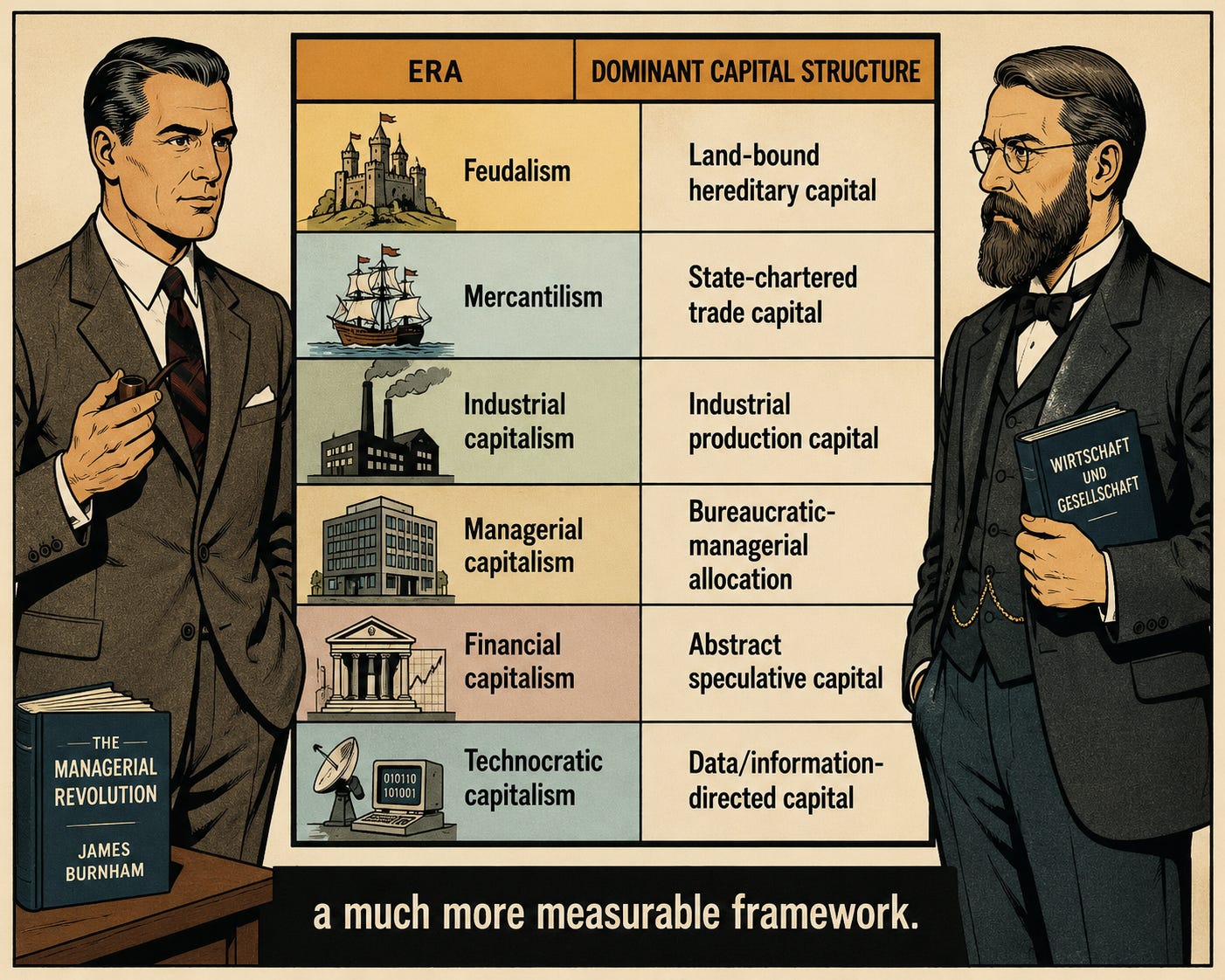
Proposed Replacement Metric
Instead of measuring societies by whether we think they are: feudal, capitalist, socialist, communist, we should instead examine in a surgical way, whether capital is meeting the ends that spread its benefit, and compare that to what we are doing now, and how it does not serve in its current utilization.
“How capital is organized and mobilized.”
That can include:
concentration of capital,
velocity of capital movement,
degree of institutional control,
bureaucratic mediation,
military allocation,
technological allocation,
financial abstraction,
diffusion vs consolidation,
productive vs consumptive deployment,
public vs private coordination,
dynastic vs managerial control,
local vs global circulation.
This would be much more concrete and scientific than anything the Marxists are currently doing, without much fruit even for themselves. Under this framework, the central question ceases to be whether a society rhetorically claims to be “capitalist” or “socialist.” The real question becomes whether the organization of capital materially strengthens the civilization beneath it.
If millions of working families cannot afford homes while tiny numbers of billionaires accumulate multiple vacant properties, luxury speculation, or abstract financial assets detached from productive civic life, that represents one state of capital allocation. It reveals a particular institutional order and a particular hierarchy of priorities. But one can easily imagine another allocation model induced through different institutional incentives, taxation structures, public investment priorities, housing systems, technological deployment, or credit allocation. Capital could instead be directed toward broad home ownership, family stability, infrastructure, productive industry, rising wages, public beauty, and long-term civic cohesion.
That is the real dialectic: not an abstract metaphysical struggle between historical labels and ideological conquest by progressive Left against a reactionary right, but a measurable struggle over how organized institutions mobilize surplus and toward what ends. This would better explain the situation, without stigmatizing all past leftist ideologies or condemning all right-wing actions as somehow easily legible class reactions holding them back.
A genuinely scientific political economy would therefore measure:
concentration versus diffusion of capital,
productive versus consumptive deployment,
bureaucratic versus local control,
financial abstraction versus material production,
managerial versus dynastic allocation,
national versus global circulation,
and whether rising wealth corresponds to a rising civic floor beneath the population itself.
This is ultimately a far more concrete framework than the increasingly elastic categories of orthodox dialectical materialism. I am not asking what history is destined to become; I do not need to claim to have history on my side, the way Leftists do because I do not think history is on anyone’s “side.” I see history as an arena where anything can happen; it is not unfolding according to upside-down Hegelian dialectics the way Marx thought. Instead my framework asks, whether the present organization of capital is actually producing a civilization worth sustaining. I am suggesting we use Dialectics in a Weberian way; that we simply talk directly about how our elites and institutions use capital, how it has been used, how it could be used.
“What Would Falsify a Weberian Dialectic?”
A Weberian dialectic is at least potentially falsifiable in a way orthodox dialectical materialism increasingly is not. If societies with radically different institutional orders consistently produced identical capital-allocation patterns, identical concentrations of wealth, identical civic outcomes, and identical relationships between elites and populations regardless of how their institutions organized surplus, then the Weberian framework would weaken substantially.
If radically different civilizations all converged mechanically toward the same developmental structure independent of religion, bureaucracy, law, elite organization, military systems, or administrative culture, then Marxist historical determinism would appear far stronger. But history does not behave this way; different institutional systems repeatedly generate divergent outcomes from similar material conditions because institutions direct capital toward different civilizational purposes.
This creates a serious Popperian problem for Marxism. A scientific framework must expose itself to possible falsification. Yet Marxist dialectics increasingly survive by expanding their interpretive elasticity after the fact. Revolutionary failure becomes “premature contradiction.” Capitalist adaptation becomes “late-stage capitalism.” Bureaucratic dictatorship becomes “degenerated worker states.” Nationalism becomes “false consciousness.” Oligarchic restoration becomes another “dialectical phase.”
The theory repeatedly absorbs contradictory outcomes without ever permitting those outcomes to fundamentally disprove the model. In practice, Marxism explains history through ideological reinterpretation rather than through precise scientific predictive clarity. Ironically, Marxism is challenged not merely by liberal capitalism, but by the actual behavior, evolution, and collapse of Marxist states themselves, alongside the enormous divergence of pre-capitalist civilizations which never followed the supposedly universal European sequence Marx believed he had discovered.
A Weberian dialectic instead begins from a narrower and more measurable premise: civilizations rise, stagnate, fragment, or decay according to how institutions organize and direct surplus over time. Civilizations decay when institutions cease directing capital toward broad civic continuity and instead redirect increasing portions of surplus toward elite insulation, speculative abstraction, bureaucratic self-preservation, administrative expansion, or detached financial accumulation removed from productive society.
Under this framework, Rome, Soviet stagnation, modern housing crises, financialized liberal economies, and technocratic managerial systems become comparable not because they occupy the same “stage” of history, but because they reveal similar patterns of institutional capital allocation. Capital possesses no civilizational purpose independent of the institutions and elites that organize it. The real material question is not what post-hoc ideological explanation for a success or failure you give a civilization but whether its organization of capital is producing a society capable of sustaining itself across generations.

Against Vulgar Marxism
This critique is directed less against every subtle ambiguity within Marx himself than against the dominant historical tendency of Marxist interpretation as it actually developed through Engelsian orthodoxy, Soviet historical materialism, deterministic party theory, and later ideological forms of dialectical materialism. Sophisticated Marxist readers are correct that Marx did not entirely ignore institutions, bureaucracy, law, culture, or political organization. Nor is Weberian sociology inherently incompatible with all forms of Marxist analysis.
My critique is therefore not that material conditions are irrelevant, nor that economic structures possess no causal force. My critique is that orthodox Marxism increasingly grants explanatory primacy to economic contradictions alone while subordinating institutions, elite organization, administrative systems, and structure into secondary reflections of “the base.”
“The economic situation is the basis, but the various elements of the superstructure... also exercise their influence upon the course of the historical struggles.”
— Friedrich Engels
Yes, Engels acknowledged this theoretically. My argument is that later orthodoxy subordinated these variables anyway. The problem is one of hierarchy and explanatory priority. In most orthodox Marxist frameworks, institutions ultimately remain downstream from material-economic contradictions and are therefore treated primarily as expressions, mediators, or consequences of the economic base rather than as partially autonomous structures capable of independently organizing, constraining, and redirecting capital itself.
In practice, later Marxist traditions often reified and quasi-deified “the base” into an overly universal explanatory engine, reducing vast civilizational complexity into secondary reflections of economic structure. Marx himself was often more historically nuanced and analytically flexible than later state orthodoxies that transformed dialectical materialism into an almost total explanatory doctrine. The problem emerged less from every ambiguity within Marx than from the tendency of later ideological systems to reduce civilizational complexity into increasingly rigid economic formulas.
A Weberian dialectic instead reopens analytical space for the dense historical “messiness” of institutional life itself: religion, military organization, legal traditions, administrative culture, elite formation, kinship systems, geography, technological inheritance, civic norms, prestige structures, and cultural legitimacy all shape how societies struggle over surplus and deploy productive power. This does not require slipping into racial essentialism or biological determinism; but it permits a more historically grounded analysis of why different civilizations, operating under different institutional inheritances and elite structures, organize capital differently.
This distinction matters because explanatory systems should be judged not merely by whether they can retroactively incorporate complexity, but by whether they clearly identify which variables possess primary causal power. A Weberian dialectic is narrower and therefore more scientifically useful precisely because it abandons claims about universal historical destiny and instead examines measurable institutional behavior: how civilizations allocate surplus, how elites organize productive capacity, how bureaucracies mediate ownership, how states direct capital, and whether those arrangements produce stability, stagnation, fragmentation, or flourishing over time.
Rather than treating every historical outcome as another adaptive “stage” within a universal dialectic, a Weberian framework asks a more limited and falsifiable question: do different institutional systems consistently organize capital differently, and do those differences produce divergent civilizational outcomes? Vilfredo Pareto, Oswald Spengler, and Gaetano Mosca all treated societies, not merely as mechanically identical economies moving through predetermined stages, but as historically distinct institutional orders shaped by elite organization, legitimacy structures, administrative cultures, collective myths, and struggles over social coordination itself. Economic conflict remains important, but it becomes only one variable embedded within a wider civilizational ecology of power, culture, hierarchy, and institutional inheritance.
That narrower scope gives the framework greater analytical precision precisely because it risks failure under observable historical comparison rather than absorbing contradiction indefinitely through reinterpretation. A Weberian dialectic therefore does not deny material forces; it denies only that material forces alone possess sufficient explanatory sovereignty over history. Human societies are not governed merely by production, but by the institutional orders through which production is organized, legitimized, constrained, inherited, weaponized, and distributed across generations.
The Worldview
This framework is not an attempt to reduce history to moral tribalism, ethnic conspiracy, or ideological mythmaking. I realize that all these explanations can make a lot of sense to people intuitively, but they are not something that 19th century Europeans would have called “a science” pre-Hitler. Conspiracies, patronage networks, and elite coordination certainly exist, as they do within all institutional systems, but they are insufficient as universal explanations for civilizational development.
Nor is the purpose of this analysis to revive nineteenth-century polemics through new ideological language. Long before Marxism, European thinkers were already dealing with enduring questions concerning elite organization, social legitimacy, imperial decline, civic cohesion, and the institutional allocation of surplus. A Weberian dialectic would returns those questions to the center of analysis while narrowing them into more measurable institutional terms. My purpose is to make the debate clear and not obfuscated behind Marxist jargon.
I do not deny all other factors and explanations, such as race and culture, merely that they are not the overarching catch all, but must exist within a framework that can explain them all without ideological additions post hoc. The real question is not which ideology claims historical inevitability, but whether a civilization can organize capital, institutions, and social legitimacy in a way capable of sustaining families, productive life, civic continuity, technological competence, and elite accountability across generations. Capital matters, but so do law, kinship, military organization, religion, legitimacy, geography, technology, elite cohesion, and cultural inheritance. The purpose of a Weberian dialectic is not to deny these forces, but to examine how institutional systems organize them into materially observable outcomes.
The problem with much contemporary ideological discourse, including forms of Marxism, is that it increasingly functions less as a framework for disciplined analysis than as a rhetorical instrument for retroactive moral interpretation; for winning arguments. That is not what I want to do here, instead I want to establish limited and observable criteria: how institutions organize capital, how elites distribute or concentrate surplus, how administrative systems shape productive life, and whether those arrangements strengthen or weaken the long-term continuity of a civilization.