
Hitler Supremacy vs. Trotsky's Developmental Snobbery: "What's the difference?"
Why racial hierarchy and revolutionary progress sound indistinguishable to those beneath them

Why racial hierarchy and revolutionary progress sound indistinguishable to those beneath them
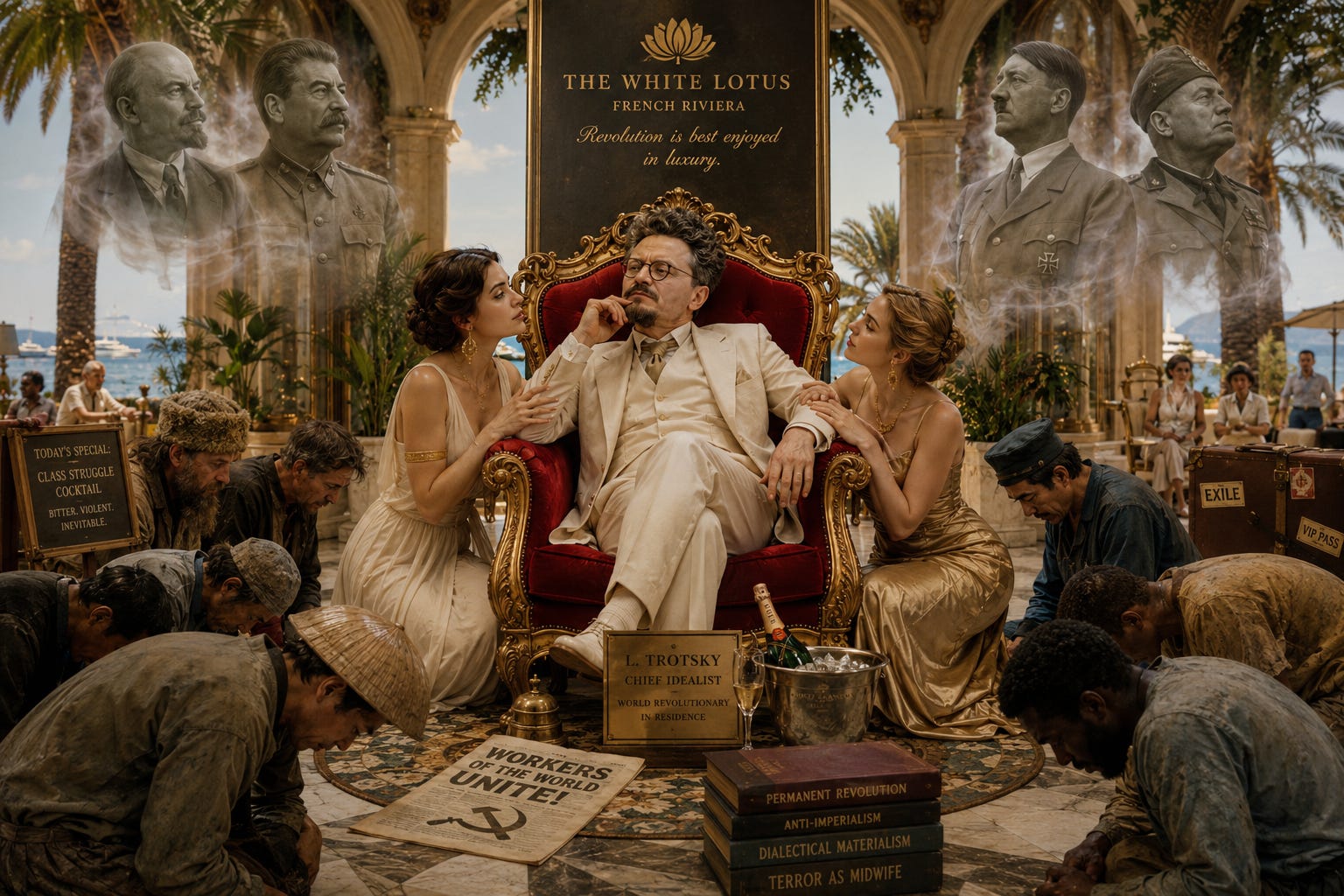
When reading a lot of Pre-modern, by which I mean, Pre-1965 Leftists, especially those born in the 1800s, in depth, and to a degree, that I know the most careerist Activist Young Leftists that I was familiar with in person, do not bother, I repeatedly came across a tendency, an attitude, a certain formulation of mind, which struck me as interesting and fascinating for what it says about its inverse. When I tried to speak exactly like that, in front of exactly those kinds of neurotic young activist Marxists, they basically took my imitation for something indistinguishable from British colonial snobbery or even German racial supremacy. Though I never dared imitate any such thing directly to their faces.
Marx rejects racial explanations in theory, but his descriptions of non-European societies often rely on a vocabulary of “backwardness,” “stagnation,” and “historical necessity” that places Europe as the implicit standard. For example, while Marx does not argue for racial superiority, he writes clearly as though European development is the measure of all things, and in that posture, in that tone, I see very little to distinguish from older hierarchies he formally rejects. If anything I see it as much the same thing, just translated to the economic historical register. Even when Marx rejects racial hierarchy in theory, his language often recreates a civilizational hierarchy in practice.
My argument is not that Marxism and National Socialism are identical doctrines, nor that their moral or historical consequences were identical; I am not making any kind of shallow “conservative” equivalence, of the kind that Leftists want to hear from someone like me, so that they can straw man and refute me. My argument is much sharper and simpler: that both could produce a remarkably similar psychological posture toward populations deemed ‘backward,’ ‘undeveloped,’ or in need of transformation and tutelage, by themselves, the good little progressives of course.
On hierarchy, historical “advancement,” and the shared language of contempt across ideological extremes
The point I am making is that when you read the works of many early Marxists, in depth, while I am well aware that before the rise of the early National Socialists, who defined an explicit racial worldview of their own, ( however much it varied by politics and rhetoric ) there is little or nothing in the Marxist canon prior to Hitler that would directly refute biological Darwinism or social Darwinism, directly.
As far as I can tell, it was only because of the Soviet victory over the Nazis, that it even became an explicit issue of the Marxist-Leninist-Stalinists, to explicitly reject the former Darwinism as some kind of “tool of the capitalist exploiters and imperialists.” Their usual charge for everything. Before that point, however, I can easily conceive of one being a Marxist, and believing in their bunk of historical dialectical materialism, while also being a Darwinian, and believing the equally cold and unfalsifiable view of the eternal struggle of the races and species. Neither view requires any moral outlook or progressive moralizing, as that which we see today.
What struck me at first glance was not that Hitlerian racial supremacy and Trotskyist developmental theory were literally the same doctrine, but that they sound disturbingly similar in tone and posture, so much so, that I see very little difference between them. The older forms of right-wing “racism” tend to speak openly of superior and inferior peoples, treating hierarchy as something natural, biological, or civilizational, with “backward” groups viewed as fit for domination, exclusion, or permanent subordination.
Trotsky, by contrast, rejected racial explanations and spoke instead in the language of historical development: “advanced” workers versus “backward” peasants, Europe as the leading edge of history, and less-developed societies needing to be accelerated, reorganized, and dragged into modernity. Yet from the perspective of the person being spoken about, the emotional texture could feel strangely alike. In both cases there emerges the voice of a self-appointed vanguard looking downward at populations deemed “behind,” and asserting the right, whether in the name of race or in the name of history, to rule, guide, discipline, or transform them.
In other words, the point I am making here, is that in the past, even more so than today, progressive snobbery is eerily indistinguishable from racial snobbery. In fact, one might surmise from history, that prior to Hitlers foolish genocidal intention of destruction against the Slavic peoples of the Soviet sphere, Trotsky’s intellectual and educational “European” snobbery was functionally seen so, by the cadres, which Stalin and others, used to write him out of their narrative. What is the difference between referring to peasants and vagabonds as economically and educationally inferior and underdeveloped, in person, and a racial snobbery, when you are the only one they are hearing from, and that is how they are made to feel.
Of course, I fully realize, that in the present day, the Left and Far-Left reject any all race realism however tepid, if it at all absolves Europeans from any charge or slander made against them on a racial basis, ( while they will indulge occasionally in racial rhetoric if it pleases the groups they wish to patronize ) however, it may be worth pointing out that there is nothing in the Marx view of Historical Determinism which precludes a belief in Biological Darwinism and Social Darwinism. If anything prior to 1945, you could easily be someone who believed in both; prior to any Russian “National Bolshevist” parodies or intimations; the one thing does not necessarily contradict the other. You could believe in both; and be a snob on either basis. ( You can also be a socialist in ideal, without taking the hard tac determinism on either question, at all times, but the claim to fame of the Leftist, is to be brutally deterministic and scientific when it suits him only on the one topic; while condemning “racism” without rational argument or refutation on collected facts. )
My only point is: snobbery is snobbery. Surely, we would condemn both to be consistent, if we are to condemn either; if we are consistent, right wing identity politics and left wing identity politics should be seen as equally “bad.” Only the Left does not treat it this way of course. You cannot ask me to condemn “racism” but then have a subculture of sneering on the poor ( when they are not in ideological alignment with you ) for their lack of educational attainment and economic development, if the poor are White and are hicks. If anything I would rather despise you and “be racist” than simply sneer at someone for being a peasant, mentally or backward, socially.
Orwell noticed, especially in The Road to Wigan Pier, that many self-described socialists did not actually like the working class in any human or cultural sense. They claimed to speak for workers while simultaneously sneering at their accents, habits, religion, patriotism, tastes, and aspirations. Trotsky’s version of this snobbery was still blunt and openly developmental: the “advanced” intellectual or worker standing above the “backward” peasant, dragging him toward History whether he wished it or not.
Modern progressivism expresses the same instinct in softer moral language, but the posture looks identical to me. I have been with their Leftist activists, often people who never experienced genuine material insecurity, accuse struggling workers of being “petit bourgeois” simply for wanting stability, property, dignity, or escape from poverty itself. The revolutionary once sneered at the peasant for clinging to tradition; the modern progressive sneers at the worker for wanting to rise above precarity. In both cases, there emerges a strange paternalism in which the educated elite claims moral authority over a class it seems to romanticize and resent at the same time.
While that one shrill British Leftist I knew flipped out at me for describing a non-European group as “primitive” in precisely the old economic-Marxist developmental sense that earlier Leftists themselves routinely used, I failed to explain sufficiently that I was simply doing, completely consistently, what nearly every Marxist prior to Adolf Hitler already did. The problem is that modern Old Leftists, New Leftists, or “progressives,” however these modern parasites choose to define themselves, do not reflect enough on their own intellectual lineage to even recognize how dramatically their rhetoric has changed over time, while their posture of intellectual arrogance has remained exactly the same.
Some Quotes from Trotsky to make my point clear to even the most Dim-witted Progressive
The  fundamental  stages  of  the  development  of mankind  we  think  will  be  established  somewhat  as  follows pre-historic  “history^’  of  primitive  man;  ancient  history, whose  rise  was  based  on  slavery;  the  Middle  Ages,  based on  serfdom;  Capitalism,  with  fiee  wage  exploitation;  and finally.  Socialist  society,  with,  let  us  hope,  its  painless
transition  to  a stateless  Commune.  At  any  rate,  the  twenty, thirty,  or  fifty  years  of  proletarian  world  revolution  will go  down  in  history  as  the  most  difficult  climb  from  one system  to  another,  but  in  no  case  as  an  independent  epoch of proletarian  culture
The fate of the colonial possessions, especially in central Asia,
would change together with the industrial evolution of the
centre, passing from direct and open robbery, including trade
robbery, to those more disguised methods which converted the
Asiatic peasants into suppliers of industrial raw material, chiefly
cotton. Hierarchically organised exploitation, combining the
barbarity of capitalism with the barbarity of patriarchal life,
successfully held down the Asiatic peoples in extreme national
abasement.Being at the same time in need of support from the latter, it forced and regimented their growth. As a result the bureaucratised privileged classes never rose to their full
height, and the Russian state thus still more approached an Asiatic despotism. The Byzantine autocratism, officially adopted by the Muscovite czars at the beginning of the sixteenth century, subdued the feudal Boyars with the help of the nobility, and then gained the subjection of the nobility by making the peasantry their slaves, and upon this foundation created the St.
Petersburg imperial absolutism. The backwardness of the whole process is sufficiently indicated in the fact that serfdom, born at the end of the sixteenth century, took form in the seventeenth, flowered in the eighteenth, and was juridically annulled only in 1861. In the Asiatic East, where the national awakening was taking place in more primitive forms, it could only by degrees and with a considerable lag come under the leadership of the proletariat—only, indeed, after the proletariat had conquered the power. If you take this complicated and contradictory process as a whole the conclusion is obvious: the national current, like
the agrarian, was pouring into the channel of the October revolution. Siberian reality carries us far deeper into an understanding of the historic peculiarities of Russia’s development than what Pokrovsky says on this subject. That is a fact. The trade operations of Jacob Andreievich extended from the midstream of the Lena and its eastern
tributaries to Nizhni-Novgorod and even Moscow. Few trades of Continental Europe can mark off such distances on their maps. However, this trade dictator—this ‘‘ king of clubs,” in the language of the Siberian farmers—was the most finished and convincing incarnation of our industrial backwardness, barbarism, primitiveness, sparseness of population, scatteredness of peasant towns and villages, impassable country roads, creating around the counties, districts and villages in the spring and autumn floods a two-months’ swampy blockade, of our universal illiteracy, etc.The backward nation, moreover, not infrequently debases the achievements borrowed from outside in the process of adapting them to its own more primitive culture. In this the very process
of assimilation acquires a self-contradictory character. Thus the introduction of certain elements of Western technique and training, above all military and industrial, under Peter I, led to a strengthening of serfdom as the fundamental form of labour organisation. European armament and European loans both indubitable products of a higher culture led to a strengthening of czarism, which delayed in its turn the development of the country. The large scope, at least in a spatial sense, of Russian trade in the sixteenth century—however paradoxical from the standpoint of the Biicher-Struve criterion—is explained exactly by the extraordinary primitiveness of Russian economy. The West European city was a craft-guild and trade-league city; our cities were above all administrative, military, consequently consuming, and not producing, centres. Conclusion
The point I am making is this: if one were simply to insert explicit racial rhetoric into many of Trotsky’s statements about “advanced” and “backward” development, he could sound indistinguishable from the spokesman of some fictional global National Socialist conspiracy, in a James Bond-like novel. That was, in fact, my first unarticulated reaction years ago when I first encountered certain Marxist texts, a private thought I kept to myself for a long time.
At the same time, I do not intend to be dishonest or simplistic here. I fully recognize that Karl Marx was not some secret racial theorist in the crude sense many modern right-wing polemicists try to portray him as being. Nevertheless, when one reads his private correspondence alongside his deterministic worldview and his ambition to construct a scientific theory of history comparable in scope to Charles Darwin, it becomes difficult not to notice that dialectical materialism emerged from the same broad European intellectual tradition that also produced many thinkers now dismissed, rightly or wrongly, as “white supremacist” or civilizationally hierarchical, from David Hume on down.
In other words, Marxism inherited not only the egalitarian aspirations of European socialism, but also the deeper European presumptions, that history moves upward along a ladder of development, with some peoples, classes, and civilizations standing “ahead” of others. A presumption that neither all men of the Right and Far-right necessarily have to hold to, anymore than the warriors of the African Burkina Faso have too. Of course, I realize that there are many cases, where a so-called “racial superior” and even an educational or developmental superior can be outwitted and displaced by someone far inferior; the life of Trotsky is a testament to that fact. He was after all, outwitted and displaced by the far inferior Stalin, that country bumpkin lumpen criminal from the Caucasus. Recognizing this does not make me a non-race realist. It simply means that I am not that deterministic about these things, whether in the Marxist way or the Darwinist. Hitler and his revolution, likewise burnt its moral and economic capital, faster than the Soviets; who died out more slowly, despite being egalitarian on the surface.
This is why, at the level of rhetoric and emotional posture, there are moments where the distance between revolutionary developmentalism and racial supremacism can appear unsettlingly narrow. If one were simply to substitute explicit racial language into certain Marxist discussions of “advanced” and “backward” peoples, or conversely replace the racial vocabulary in Mein Kampf, with the colder economic and historical language of dialectical materialism, the underlying cadence of superiority sounds identical. The Marxist hierarchy is theoretically temporary and historical; the racial hierarchy is claimed to be natural and enduring; in reality, both sides aim for permanence when they get power. Either way, there will be a boot stomping on someone’s face, forever.
The categories change, race in one case, historical development in the other, but both can produce the image of a self-appointed vanguard standing above supposedly “less advanced” populations and claiming the authority to discipline, transform, or supersede them. The difference is real and intellectually important: one hierarchy presents itself as biological and permanent, the other is claimed as historical and temporary. Yet to the ordinary person being spoken about from above, that distinction feels less emotionally obvious than theorists on either side would prefer to admit. And that is how I personally see it. Thus, when you present me with racial snobbery or some vague “this is temporary, honest, trust us,” progressive Leftist developmental class-based inevitability snobbery, my reaction is, “I do not see the fucking difference.”
If you look at this in a certain light, you can see it as “Jewish Marxists” being effective “German Supremacists” long before Hitler, albeit, they were not racial supremacists in a crass way; they were something colder, they were “Developmental Supremacists.” They thought the Germans and the British were the best, because of what the Germans and the British could produce and organize. That is a historical developmental supremacy, which can be no less hubristic than the racial supremacy. The thing is, if you think a civilization is great because of what freedoms it can grant, what organization, it can constrain and what production it can maintain, it is a very slight move to think other things. At some point the material product of Rome must give some credit to the Romans; at some point the horse must give credit to the horse trainer. As far as I am concerned, the two things, amount to the same thing.